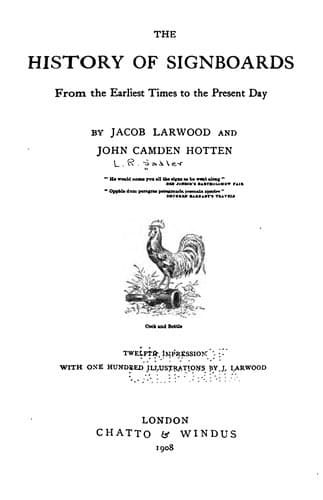
The History of Signboards, from the Earliest times to the Present DayHotten, John Camden
History
The History of Signboards, from the Earliest times to the Present Day
Hotten, John Camden
Inn signs -- England -- History; Signs and signboards -- History
“I remember one citizen, who, having thus broken out of his house in
Aldersgate Street, or there about, went along the road to Islington.
He attempted to have gone in at the Angel Inn, and after that at the
White Horse, two inns known still by the same signs, but was refused;
after which he came to the _Pied Bull_, an inn also still continuing
the same sign. He asked them for lodging for one night only,
pretending to be going into Lincolnshire, and assuring them of his
being very sound, and free from the infection, which also at that time
had not reached much that way. They told him they had no lodging, that
they could spare but one bed up in the garret, and that they could
spare that bed but for one night, some drovers being expected the next
day with cattle; so if he would accept of that lodging, he might have
it, which he did; so a servant was sent up with a candle with him, to
show him the room. He was very well dressed, and looked like a person
not used to lie in a garret; and when he came to the room he fetched a
deep sigh, and said to the servant, ‘I have seldom lain in such a
lodging as this;’ however, the servant assured him again that they had
no better. ‘Well,’ says he, ‘I must make shift; this is a dreadful
time, but it is but for one night.’ So he sat down upon the bed-side,
and bade the maid, I think it was, fetch him up a pint of warm ale.
Accordingly the servant went for the ale; but some hurry in the house,
which perhaps employed her otherwise, put it out of her head, and she
went up no more to him. The next morning, seeing no appearance of the
gentleman, somebody in the house asked the servant that had showed him
up stairs, what was become of him. She started; ‘alas,’ said she, ‘I
never thought more of him; he bade me carry him some warm ale, but I
forgot.’ Upon which, not the maid, but some other person was sent up
to see after him, who coming into the room found him stark dead, and
almost cold, stretched out across the bed. His clothes were pulled
off, his jaw fallen, his eyes open in a most frightful posture, the
rug of the bed being grasped hard in one of his hands; so that it was
plain he died soon after the maid left him; and that it is probable,
had she gone up with the ale, she had found him dead in a few minutes
after he sat down upon the bed. The alarm was great in the house, as
any one may suppose, they having been free from the distemper till
that disaster; which bringing the infection to the house, spread it
immediately to other houses round about it. I do not remember how many
died in the house itself, but I think the maid-servant who went up
first with him, fell presently ill by the fright, and several others;
for whereas there died but two in Islington of the plague the week
before, there died seventeen the week after, whereof fourteen were of
the plague. This was in the week from the 11th of July to the
18th.”[256]
Public-domain text, read in full here on John Shaqi.
Reviews
Reviews
No reviews yet
Be the first to share your thoughts on this work.
Elsewhere in the archive
Join the Discussion
Join the discussion
Sign in to leave a comment or review.
Sign InorCreate an account