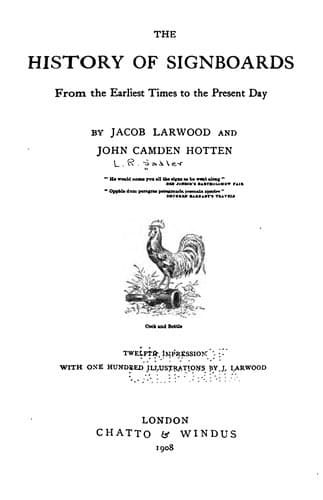
The History of Signboards, from the Earliest times to the Present DayHotten, John Camden
History
The History of Signboards, from the Earliest times to the Present Day
Hotten, John Camden
Inn signs -- England -- History; Signs and signboards -- History
The RED BULL was the sign of another of the inn-playhouses in
Shakespeare’s time; but, like the Fortune, mostly frequented by the
meaner sorts of people. It was situated in Woodbridge Street,[257]
Clerkenwell, (its site is still called Red Bull Yard,) and is supposed
to have been erected in the early part of Queen Elizabeth’s reign. At
all events, it was one of the seventeen playhouses that arose in London
between that period and the reign of Charles I. Edward Alleyn the actor,
founder of Dulwich College, says in a memorandum, Oct. 3, 1617, “went to
the Red Bull and received for the ‘Younger Brother’ [a play], but
£3-6-4.” Killigrew’s troop of the king’s players performed in it until
the theatre in Lincoln’s-Inn-fields opened. The place was then abandoned
to exhibitions of gladiators and feats of strength. The names of the
principal theatres at the time of the Commonwealth occur in the
following puritanical curse:--
“---- That the _Globe_
Wherein (quoth he) reigns a whole world of vice,
Had been consumed, the _Phenix_ burnt to ashes,
The _Fortune_ whipp’d for a blind--_Blackfriars_,
He wonders how it ’scaped demolishing
I’ the time of Reformation; lastly he wished
The _Bull_ might cross the Thames to the _Bear-gardens_,
And there be soundly baited.”[258]
The BULL’S HEAD is often seen instead of the Bull; its origin may be
from the butchers’ arms, which are azure two axes salterwise, arg.
between two roses _arg._ as many _bulls’ heads_ couped of the second
attired _or_, &c.; in Holland a carved bull’s head is always a
leather-seller’s sign. At the BULL’S HEAD, in Claremarket, the artists’
club used to meet, of which Hogarth was a member, and Dr Ratcliffe a
constant visitor. The Bull’s Head was already used in signs three
hundred years ago, as we may see from an entry in Machyn’s Diary, which
does not say much for the morality of the period:--
“The xij day of June (1560) dyd ryd in a care[259] abowt London ij men
and iij women; one man, for he was the bowd and to brynge women unto
strangers; and on women was the wyff of the _Bell_ in Gracyous Strett;
and a-nodur the wyff of the _Bull-hed_ besyd London Stone, and boyth
were bawdes and hores and the thodur man and the woman were brodur and
syster and wher taken nakyd together.”
As a variation, on the Bull’s Head there is the COW’S FACE:--
“GEORGE TURNIDGE, aged about 16, a short thickset Lad with a little
dark brown Hair, a scar in his left cheek under his eye, wears a
canvass jacket lined with red and canvass Breeches, with a red cap,
run away from his Master the 7th instant. Whoever secures him and
gives Notice to Mr Henry Davis, Waxchandler at the Cow’s Face in Miles
Lane in Canon Street, shall have a Guinea Reward, and reasonable
charges.”--_London Gazette_, Jan. 13-17, 1697.
Public-domain text, read in full here on John Shaqi.
Reviews
Reviews
No reviews yet
Be the first to share your thoughts on this work.
Elsewhere in the archive
Join the Discussion
Join the discussion
Sign in to leave a comment or review.
Sign InorCreate an account