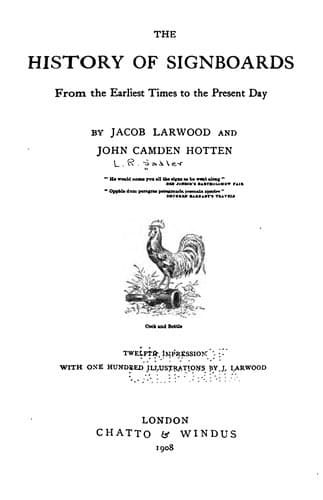
The History of Signboards, from the Earliest times to the Present DayHotten, John Camden
History
The History of Signboards, from the Earliest times to the Present Day
Hotten, John Camden
Inn signs -- England -- History; Signs and signboards -- History
A walk through town on a fine Sunday morning will at once convince
anybody of the good understanding that exists between the Englishmen and
the canine species, “l’ami de l’homme” as Buffon calls the dog. From
every lane and alley in the lower parts of the town sally forth men and
youths in clean moleskins and corduroys, each invariably accompanied by
some yelping cur, the least of whose faults is to be ugly. It is no
wonder, then, that the DOG should be of frequent occurrence on the
signboard. Pepys mentions a tavern of that name in Westminster, where,
about the time of the Restoration, he used occasionally to show his
merry face. In 1768, the author of the “Art of Living in London,”
recommended the Dog in Holywell Street for a quiet good dinner:--
“Where disencumbered of all form or show,
We to a moment might or sit or go;
Eat what the palate recommends us hot,
Yet not considered as a useless guest.”
[Illustration: PLATE IX.
GOOSE AND GRIDIRON.
(St Paul’s Churchyard, circa 1800.)
ANGEL AND GLOVE.
(Harleian Collection, 1710.)
THREE KINGS.
(Banks’s Collection, 1720.)
MARYGOLD.
(Child’s Bank, Fleet Street, circa 1670.)
GUY OF WARWICK.
(Roxburghe Ballads, circa 1650.)]
For some unknown reason, the BLACK DOG seems the greatest favourite;
perhaps the English terrier is meant by it, a dog who “once had its
day,” as the Scotch terrier appears to have it now. In the seventeenth
century, there was a Black Dog Tavern near Newgate; a house of old
standing, of which trades tokens are yet extant.
Public-domain text, read in full here on John Shaqi.
Reviews
Reviews
No reviews yet
Be the first to share your thoughts on this work.
Elsewhere in the archive
Join the Discussion
Join the discussion
Sign in to leave a comment or review.
Sign InorCreate an account