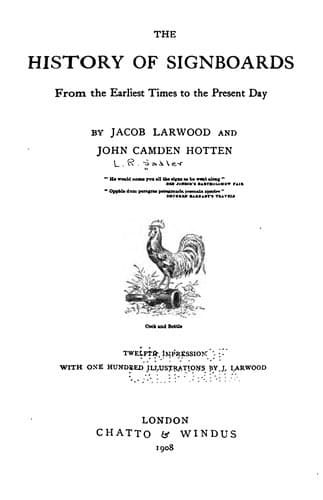
The History of Signboards, from the Earliest times to the Present DayHotten, John Camden
History
The History of Signboards, from the Earliest times to the Present Day
Hotten, John Camden
Inn signs -- England -- History; Signs and signboards -- History
The CAT AND PARROT was, in 1612, the sign of Thomas Pauer, a bookseller,
dwelling near the Royal Exchange. At Santry, near Dublin, and in some
other places, we meet with the CAT AND CAGE, which is represented by a
cat trying to pull a bird out of a cage; but its origin may be found in
the CAT IN THE BASKET, a favourite sign of the booths on the Thames when
that river was frozen over in 1739/40. The sign was a living one, a
basket hanging outside the booth, with a cat in it. It was revived when
the river was again frozen in 1789, and seems to have had many
imitators, for on a print[279] representing a view of the river at
Rotherithe during the frost, there is a booth with a merry company
within, whose sign, inscribed the _Original_ CAT IN THE CAGE, represents
poor Tabby in a basket. This sign of the Cat in the Basket, or in the
Cage, doubtless originated from the cruel game, once practised by our
ancestors, of shooting at a cat in a basket. Brand, in his “Popular
Superstitions,” gives a quotation, from which it appears that a similar
cruel sport was still practised at Kelso in 1789; but instead of
shooting at the cat, it was placed in a barrel, the bottom of which had
to be beaten out. The same game is still practised in Holland, and
generally, if not always, on the ice.
[196] J. Bossewell, Workes of Armourie, London, 1597, p. 97.
[197] “Allectorius is a stone similar to a dark crystal, which is taken
from the stomach of a capon when it is four years old. Its utmost size
is that of a bean. Gladiators take it in their mouths in order to be
invincible, and not to suffer from thirst.”--_Tractatus de Animalibus et
Lapidibus_, 4to, _circa_ 1465-75.
[198] Guillim’s Display of Heraldry. The same is also related in the
Latin Bestiarium. Harl. MSS. 4751; and by Albertus Magnus, Camerarius,
&c.
[199] “Boyne’s and Akerman’s Trades Tokens of the 17th Century,” in
England, Ireland, and Wales.
[200] Steward’s Accounts of Sir John Howard.
[201] See Cunningham’s London Past and Present, p. 41.
[202] Burnet’s History of the Reformation, Lib. ii., vol. ii., p. 14. It
is possible also that the White Bear was set up in compliment to Anne,
daughter of the Earl of Warwick, queen to Richard III., who, as a
difference from her father’s bear and ragged staff, had adopted the
White Bear as a badge.
[203] Timbs’s Flyleaves.
[204] Bagford, who was present at the excavations, relates this story in
a letter prefixed to Leland’s Collectanea, p. lxiii., 1770. See also Sir
John Oldcastle.
[205] “Lambspring, das ist ein herzlichen Teutscher Tractat von
Philosophischen Steine, welchen für Jahren ein adelicher Teutscher
Philosophus, Lampert Spring geheissen mit schöne Figuren beschrieben
hat. _Frankfort am Main_, 1625.”
[206] “This is a great wonder, and very strange: the dragon contains the
greatest medicament.”
[207] “Mercury rightly precipitated or sublimated in its own water
dissolved and again coagulated.”
Public-domain text, read in full here on John Shaqi.
Reviews
Reviews
No reviews yet
Be the first to share your thoughts on this work.
Elsewhere in the archive
Join the Discussion
Join the discussion
Sign in to leave a comment or review.
Sign InorCreate an account