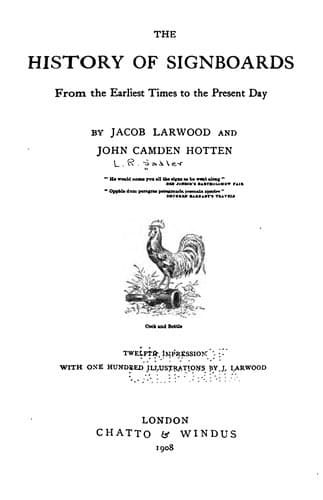
The History of Signboards, from the Earliest times to the Present DayHotten, John Camden
History
The History of Signboards, from the Earliest times to the Present Day
Hotten, John Camden
Inn signs -- England -- History; Signs and signboards -- History
[208] “There is a dragon lives in the forest who has no want of poison:
when he sees the sun or fire he spits venom, which flies about
fearfully. No living animal can be cured of it; even the basilisk does
not equal him. He who can properly kill this serpent has overcome all
his danger. His colours increase in death; physic is produced from his
poison, which he entirely consumes, and eats his own venomous tail. This
must be accomplished by him in order to produce the noblest balm. Such
great virtue as will point out herein that all the learned shall
rejoice.”
[209] Bossewell, Workes of Armourie, p. 61.
[210] Allusions to the unicorn occur frequently in the Old Testament,
and commentators inform us that these references were typical of the
coming Saviour.
[211] “It is reported that the unicorn’s horn sweats when it comes in
the presence of poison, and that for this reason it is laid on the
tables of the great, and made into knife-handles, which, when placed on
the tables, show the presence of poison. But this is not sufficiently
proved.”--Albertus Magnus, De Animalibus, lib. xxv.
[212] Bib. Harl. 5953, vol. i., p. 403.
[213] Relation of the Island of England, published by the Camden
Society.
[214] See Bib. Harl. 5953, vol. i., p. 407.
[215] Hentzner’s Travels, p. 54.
[216] Henry Peacham’s Compleat Gentleman.
[217] Fuller’s Worthies, _voce_ Middlesex.
[218] “It is rather peculiar that the same superstitious notions should
be found in India in connexion with the horn of the rhinoceros, whom
some consider as the fabled unicorn divested of his romantic garb. His
horn, too, was thought useful in diseases, and for the purpose of
discovering poisons.”--_Calmet’s Dictionary of the Bible._ “The fine
shavings were supposed to cure convulsions and spasms in children.
Goblets made of these would discover a poisonous draught that was poured
into them, by making the liquor ferment till it ran quite out of the
goblet.”--_Thunberg’s Journey to Caffraria._
[219] _Daily Courant_, February 2, 1711.
[220] “This is the Civet, as you may see; but enter. Perfumes sold here
for men and women.”
[221] The reason why the hedgehog was generally represented with apples
stuck on his quills, appears from the following words in Bossewell, (p.
61,)--“He clymeth upon a vine or an apple-tree and biteth off their
braunches and twigges, and when they [the apples] be fallen downe, he
waloweth on them, and so they sticke on his prickes, and he beareth them
unto a hollow tree or some other hole.” The early naturalists also said
that if, when he was so loaded, one of the apples happened to drop off,
he would throw all the others down in anger and return to the tree for a
new load.
[222] Harl. MSS. 353, fol. 145.
[223] _London Gazette_, No. 368.
[224] _London Gazette_, Sept. 18-21, 1682. I am confident the newspapers
made a misprint, and that the man’s name was Haase, Dutch or German, for
the Hare he represented on his sign.
Public-domain text, read in full here on John Shaqi.
Reviews
Reviews
No reviews yet
Be the first to share your thoughts on this work.
Elsewhere in the archive
Join the Discussion
Join the discussion
Sign in to leave a comment or review.
Sign InorCreate an account