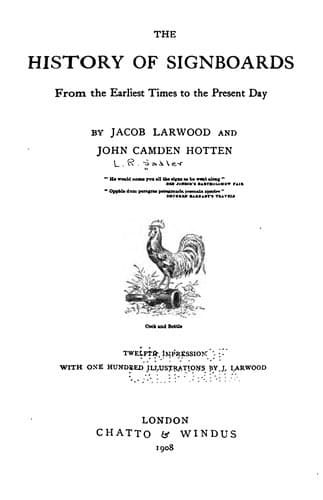
The History of Signboards, from the Earliest times to the Present DayHotten, John Camden
History
The History of Signboards, from the Earliest times to the Present Day
Hotten, John Camden
Inn signs -- England -- History; Signs and signboards -- History
[225] Hone’s Every-Day Book, Oct. 17, fol. 1.
[226] Rev. J. Richardson, LL.B., Recollections of the Last Half Century.
See also under STUNNING JOE BANKS in the Slang Dictionary, recently
issued by the publisher of this work.
[227] _Gentleman’s Magazine_, March 1842.
[228] _See_ under RELIGIOUS SIGNS.
[229] _London Gazette_, Oct. 2-6, 1673.
[230] Childe Harold, canto I. lxx.
[231] Hone’s Every Day Book, Jan. 17, vol. ii.
[232]
“I wear horns, which everybody sees,
But many a one wears horns and does not know it.”
[233] Bagford Bills. Bib. Harl. 5962.
[234] _Postman_, February 1-3, 1711.
[235] Richardsoniana, p. 168.
[236] Timbs, Curiosities of London, p. 402.
[237] As quoted by Strutt in “Gliggam,” &c.
[238] Printed in Leland’s Collectanea, pp. 270, 272.
[239] A MS. of the sixteenth century, Bib. Harl. 2150, fol. 356, gives
full particulars of this _fête_ and procession.
[240]
“At the White Horse, horses are shod with iron,
Pity the same cannot be done to men, for then they would need no
shoes.”
[241] Crowns exactly similar to this, made of box, tinsel, and coloured
paper, are yearly hung out by the fishmongers in Holland on the first
arrival of the salt herring after the summer fishery.
[242] Pennant’s Account of London, p. 423.
[243] _Gentleman’s Magazine_, March 1842; and _London Gazette_, Dec. 30,
1718.
[244] Lloyd’s _Evening Post_, Jan. 16-19, 1761.
[245] Brand’s Popular Superstitions.
[246] Robert Herrick, Hesperides, p. 234.
[247] Aubrey, Anecdotes and Traditions, p. 3.
[248] _Postman_, June 1703.
[249] _Intelligencer_, May 30, 1681.
[250] Bagford Bills. Bib. Harl. 5964.
[251] Hence we have 7 ages, 7 churches, 7 champions, 7 penitential
psalms, 7 sleepers of Ephesus, 7 years’ apprenticeship, 7 cardinal
virtues and deadly sins, 7 make a gallows-ful, boots of 7 leagues, 7
liberal arts, and innumerable other instances.
[252] Collier’s Annals, vol. iii. p. 271, and Halliwell’s Introduction
to Tarlton’s Jests, p. 16.
[253] _Spectator_, No. 509.
[254] “He went about almost naked in the rage of hunger,” says Dr
Johnson, “and finding a gentleman in a neighbouring coffeehouse asked
him for a shilling; and Otway going away bought a roll and was choked
with the first mouthful.”
[255] Lewis’s Islington, p. 160.
[256] The History of the Plague, by Defoe.
[257] There is still a BULL’S HEAD public-house in this street, built on
the site of the house of Thomas Britton, the Musical Small-Coal Man,
where he gave his celebrated concerts for a period of 36 years, powdered
duchesses and fastidious ladies of the Court tripping through his coal
repository, and climbing up a ladder to assist at these famous meetings.
[258] Randolph’s Muses’ Looking-Glass.
Public-domain text, read in full here on John Shaqi.
Reviews
Reviews
No reviews yet
Be the first to share your thoughts on this work.
Elsewhere in the archive
Join the Discussion
Join the discussion
Sign in to leave a comment or review.
Sign InorCreate an account