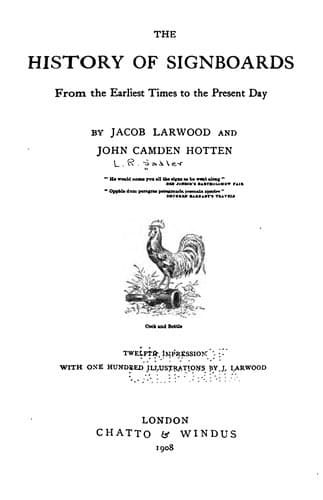
The History of Signboards, from the Earliest times to the Present DayHotten, John Camden
History
The History of Signboards, from the Earliest times to the Present Day
Hotten, John Camden
Inn signs -- England -- History; Signs and signboards -- History
[259] This riding in a cart was a very ancient punishment, probably
introduced by the Normans; in the romance of Lancelot du Lac the cart is
mentioned with the following remarks:--“At that time a cart was
considered so vile that nobody ever went into it, but those who had lost
all honour and good name; and when a person was to be degraded, he was
made to ride in a cart, for a cart served at that time for the same
purpose as the pillory now-a-days, and each town had only one of them.”
In the old English laws it was called the _Tumbrill_; thus Edward I. in
1240 enacted a law by which millers stealing corn were to be chastised
by the Tumbrill.--See _Fabian’s Chronicles_, 2 Edw. I.
[260] For the chequered life of this strange individual, see Caulfield’s
Memoirs of Remarkable Persons, vol. ii. From the _Original Weekly
Journal_, Sept. 13, 1718, we gather the information that, “Last week
_Dr_ Campbell, the famous dumb fortune-teller, was married to a
gentlewoman of considerable fortune in Shadwell.”
[261] A curious story of _Bulleyn Butchered_, the sign said to have been
put up in commemoration of Henry VIII.’s unfortunate queen, and its
corrupted form of _Bull and Butcher_ will be found in the first division
of this work. _Vide_ HISTORICAL SIGNS.
[262] “Be happy while you live.”
[263] M. Misson’s Memoirs and Observations on his Travels in England,
1719.
[264] Tom Brown’s Amusements for the Meridian of London, 1700.
[265] From a MS., entitled “Medycine Boke” of one Samson Jones, doctor
of Bettws, Monmouthshire, 1650-90; a note on the flyleaf says, “I had
this book from Mr Owen of Bettws, Monmouth. He assured me he knew for a
fact it was the receipt booke of Samson Jones, a good doctor of that
parish, a hundred and fifty years agone.” It contains some extraordinary
prescriptions. Surely if Master Samson Jones made use of them, the earth
must very quickly have hidden his blunders.
[266] _London Gazette_, Nov. 10-13, 1673.
[267] _Idem_, March 24-28, 1761.
[268] _Public Advertiser_, March 4, 1759.
[269] _Postman_, Feb. 13, 1711.
[270] See under HUMOROUS SIGNS, further on.
[271] See under HUMOROUS SIGNS, further on.
[272] _Kingdom’s Intelligencer_, March 30 to April 6, 1683.
[273] The Merry Man’s Resolution, or his last farewell to his former
acquaintance. Rox Ball. iii. f. 242.
[274] Strype, B. iii. p. 195.
[275] _Public Advertiser_, March 1759.
[276] Organs were first introduced in taverns during the Commonwealth.
When the liturgy and the use of organs in Divine service were abolished,
these instruments being removed from churches, were set up in inns and
taverns. Hence a pamphlet of 1659 has these words:--“They have
translated the organs out of their churches and set them up in taverns,
chaunting their dithyrambics and bestial Bacchanalias to the tune of
those instruments which were wonted to assist them in the celebration of
God’s praises.”
[277] Garrick’s Prologue to the Maid of the Oaks, 1774.
Public-domain text, read in full here on John Shaqi.
Reviews
Reviews
No reviews yet
Be the first to share your thoughts on this work.
Elsewhere in the archive
Join the Discussion
Join the discussion
Sign in to leave a comment or review.
Sign InorCreate an account