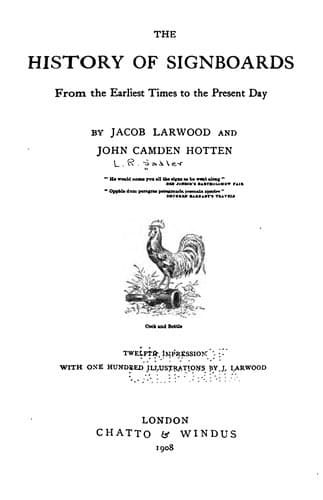
The History of Signboards, from the Earliest times to the Present DayHotten, John Camden
History
The History of Signboards, from the Earliest times to the Present Day
Hotten, John Camden
Inn signs -- England -- History; Signs and signboards -- History
[278] La Haye, par de Fonseca. 1853.
[279] Crowle Pennant, vol. viii.
CHAPTER V.
BIRDS AND FOWLS
Thomas Coryatt, a gentleman from Somerset, who travelled over a great
part of Europe in the reign of King James I., and wrote an amusing
account of his travels, gives a curious instance of the prevalence of
signs in Paris representing birds. Speaking of the bridges over the
Seine, he says one of them is “the Bridge of Birdes, formerly called the
Millar’s Bridge. The reason why it is called the Bridge of Birdes is
because all the signes belonging unto shops on each side of the streete
are signes of birdes.”[280] They never were so general in England,
though certainly the Cock and the Swan appear to have found more
votaries than any other signboard animals. The EAGLE is not nearly so
common; some we have mentioned in a former part as undoubtedly of
_heraldic_ origin. From this source the GOLDEN EAGLE may be derived; it
was the emblem of the Eastern Empire, and occurs in various family arms;
but it is also a _fera naturæ_. It was, in 1711, the sign of James Levi,
a bookseller in the Strand, near the Fountain Tavern. The EAGLE AND
BALL, of which there are two in Birmingham, was suggested by the
imperial eagle standing on the globe, or the spread eagle with the globe
in his talon. The EAGLE AND SERPENT, or the EAGLE AND SNAKE, is a
mediæval emblem of courage united to prudence.
Mythical birds also have been in great favour. The burning and reviving
of the PHŒNIX, for instance, like the salamander and the dragon,
typified certain transformations obtained by chemistry, whence he was a
very general sign with chemists, and may still be seen on their
drug-pots and transparent lamps. The firm of Godfrey and Cooke, for
instance, have adhered to it ever since the opening of their
establishment, A.D. 1680. Persons of a highly imaginative turn will
probably shudder to think of the awful quantities of physic prepared by
this house in those 184 years. The pills, if piled up like cannon-balls,
would make pyramids higher than those of Gizeh; the draughts would be
sufficient to cover the earth with a nauseous deluge; and the powders,
if blown about by an evil wind, levelling valleys and mountains, would
change the whole of Europe into a medicated desert. The original shop
referred to by the date 1680 stood in Southampton Street, and there
phosphorus was first manufactured by the predecessor of this firm,
Hanckwitz, a Pole or Russian by birth, who advertised it wholesale at
50s., and retail at £3 the ounce. Ambrose Godfrey was his successor.
Public-domain text, read in full here on John Shaqi.
Reviews
Reviews
No reviews yet
Be the first to share your thoughts on this work.
Elsewhere in the archive
Join the Discussion
Join the discussion
Sign in to leave a comment or review.
Sign InorCreate an account