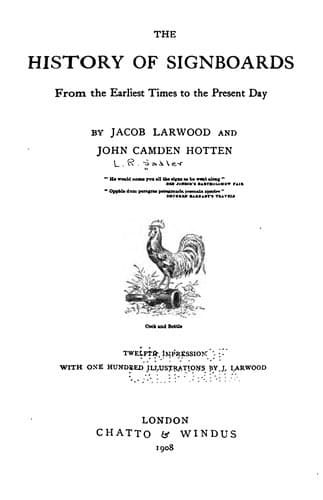
The History of Signboards, from the Earliest times to the Present DayHotten, John Camden
History
The History of Signboards, from the Earliest times to the Present Day
Hotten, John Camden
Inn signs -- England -- History; Signs and signboards -- History
Not only apothecaries used this emblem, but all kinds of shops adopted
it. In the time of James I. it was the sign of one of the places where
plays were acted in Drury Lane,--sometimes also called the Cockpit
Theatre. This was destroyed by the unruly apprentices during one of
their saturnalia. Being rebuilt, it was sacked a second time by the
Parliamentary soldiers. In Charles II.’s piping times of peace
Killigrew’s troop of “the king’s servants” played in it, until they
removed to the theatre in Lincoln’s Inn.
The character ascribed to the PELICAN was fully as fabulous as that of
the Phœnix. From a clumsy, gluttonous, piscivorous water-bird, it was
transformed into a mystic emblem of Christ, whom Dante calls “nostro
Pellicano.” St Hieronymus gives the story of the pelican restoring its
young ones destroyed by serpents, as an illustration of the destruction
of man by the old serpent, and his salvation by the blood of Christ. The
“Bestiarium,” in the Royal Library at Brussels, says:--
“Phisiologus dist del Pellican qu’il aime moult ses oiseles et quant
ils sont nés et creu ils s’esbanoient en lor ni contre lor pere et le
fierent de lors eles en ventilant ensi come il li vont entor et tant
le fierent qu’ils le blechent es ex. Et lors les refiert li peres et
les occit. Et la mere est de tel nature que ele vient al ni al tierc
jor et s’accoste sor ses oiselès mors et ell oevre son costé de son
bec et en espant son sanc sor ses oiseles et ensi les resucite de
mort; car li oiseles par nature rechoivent le sang si toit come il
saut de la mere et le boivent.”[281]
In the Armory of Birds by Skelton, a similar notion is expressed:
“Than sayd the Pellycane,
When my Byrdts be slayne,
With my Bloude I them reuyue,
Scrypture doth record
The same dyd our Lord,
And rose from deth to lyue.”
There is still an old stone carving of the Pelican walled in the front
of a house in Aldermanbury, and as a sign the bird appears to be a great
favourite at the present day. An anecdote is told of Jekyl’s
dissatisfaction at the prices at the Pelican Inn, Speenham Land, and of
his writing the following epigram upon the same:--
“The Pelican at Speenhamland,
That stands below the hill,
May well be called the Pelican,
From his enormous _bill_.”
Longfellow made a similar epigram on the RAVEN INN at Zurich:--
“Beware of the raven of Zurich,
’Tis a bird of omen ill,
With a noisy and unclean breast,
And a very, very long _bill_.”
It is amusing to see how wit runs in the same channel. In “Scrapeana, a
Collection of Anecdotes, 1792,” a similar anecdote is fathered upon
Foote. “Pray what is your name?” said Foote to the Master of the Castle
Inn at Salthill. “Partridge, sir!”--“Partridge! it should be Woodcock by
the length of your _bill_!”
Public-domain text, read in full here on John Shaqi.
Reviews
Reviews
No reviews yet
Be the first to share your thoughts on this work.
Elsewhere in the archive
Join the Discussion
Join the discussion
Sign in to leave a comment or review.
Sign InorCreate an account