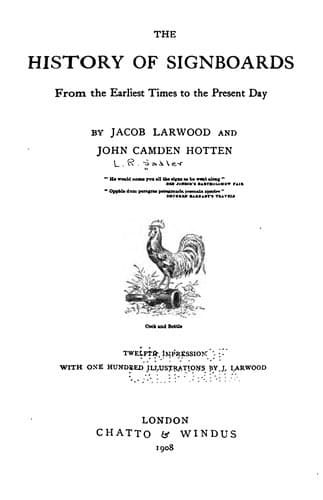
The History of Signboards, from the Earliest times to the Present DayHotten, John Camden
History
The History of Signboards, from the Earliest times to the Present Day
Hotten, John Camden
Inn signs -- England -- History; Signs and signboards -- History
But the coincidence is most amusing in the case of Longfellow. It is
observed by a contributor to _Notes and Queries_,[282] that the verses
may be a plagiarism; at any rate they have a strange _family_
resemblance to the following, said to have been written by a commercial
traveller on an inside window shutter of the GOLDEN LION, Brecon, kept
by a Mr Longfellow, alias Tom Longfellow:--
“Tom Longfellow’s name is most justly his due,
Long his neck, long his _bill_, which is very long too;
Long the time ere your horse to the stable is led,
Long before he’s rubbed down, and much longer till fed.
Long indeed may you sit in a comfortless room,
Till from kitchen, long dirty, your dinners shall come.
Long the often-told tale that your host will relate,
Long his face while complaining how long people eat,
Long may Longfellow long ere he see me again,
Long ’twill be ere I long for Tom Longfellow’s inn.”
And long, doubtless, was his face when he read the above.
The RAVEN, or the BLACK RAVEN, is still a common inn sign. There is one
in Bishopsgate yet in existence, of which trades tokens of the
seventeenth century are extant; and on the Great Western Road between
Murrell Green and Basingstoke, the Raven Inn is still, or was not many
years ago, to be seen, in which Jack the painter, alias James Aitken,
the man who set fire to Portsmouth Dockyard, Dec. 7, 1776, was taken
prisoner. This house was built in 1653, and has preserved much of its
original appearance. In 1711 the RAVEN or the BLACK RAVEN was the sign
of S. Popping, bookseller in Paternoster Row; and about the same time
John Dunton published at the BLACK RAVEN, in the Poultry, the earliest
printed review of literary works, under the name of “Literature from the
North, and News from all Nations.” What the work was worth we may judge
from D’Israeli’s description of the man: “a crack-brained, scribbling
bookseller, who boasted he had a thousand projects, fancied he had
methodised six hundred, and was ruined by the fifty he executed.”
Notwithstanding this, his autobiography, under the name of the “Life and
Errors of John Dunton,” is one of the most curious works in existence.
In Molesworth Street, Dublin, there is a sign of the THREE RAVENS, which
may be called a living sign, for there are always some ravens kept on
the premises. The Raven was the badge of the old Scotch kings, and thus
may have been adopted as a kind of Jacobite symbol. To this may be
attributed its frequency on the signboard as well as some other sable
birds. The common occurrence of the BLACKBIRD and the COCK AND BLACKBIRD
as signs had long puzzled us, till one day turning over some old Scotch
ballads we came upon one, which Allan Ramsay gives as a favourite old
Scotch song. We shall merely quote the first two stanzas, (there are six
in all,)--quite sufficient, as far as the poetry is concerned:--
Public-domain text, read in full here on John Shaqi.
Reviews
Reviews
No reviews yet
Be the first to share your thoughts on this work.
Elsewhere in the archive
Join the Discussion
Join the discussion
Sign in to leave a comment or review.
Sign InorCreate an account