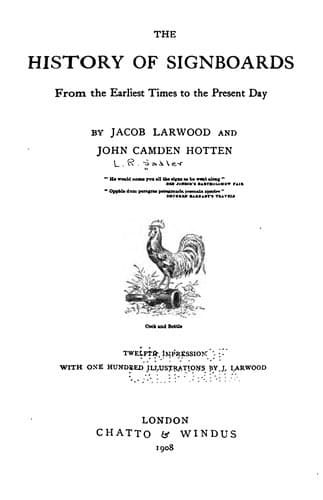
The History of Signboards, from the Earliest times to the Present DayHotten, John Camden
History
The History of Signboards, from the Earliest times to the Present Day
Hotten, John Camden
Inn signs -- England -- History; Signs and signboards -- History
“Upon a fair morning for soft recreation,
I heard a fair lady was making her moan,
With sighing and sobbing, and sad lamentation,
Saying, _my blackbird most royal_ is flown.”
My thoughts they deceive me,
Reflections do grieve me,
And am o’erburthen’d with sad misery.
Yet if death should blind me,
As true love inclines me,
My blackbird I’ll seek out wherever he be.
“Once in fair England my blackbird did flourish,
He was the _chief blackbird that in it did spring_,
Prime ladies of honour his person did nourish,
_Because he was the true son of a king_.
But since that false fortune,
Which still is uncertain,
Has caused this parting between him and me,
His name I’ll advance,
In Spain and in France,
And I’ll seek out my blackbird wherever he be.”
To which dark-haired prince of the Stuart family the song alludes is not
known; but there is a passage in a letter of Sir John Hinton, physician
to Charles II., which seems to imply that the black boy was a nickname
for Charles II.
“The day before General Monk went into Scotland he dined with me; and
after dinner he called me into the next room, and after some
discourse, taking a lusty glass of wine, he drank a health to his
_bonny black boy_, (as he called Your Majesty,) and whispered to me,
that if ever he had power, he would serve Your Majesty to the utmost
of his life.”[283]
What lends strength to the supposition is the occurrence of such a sign
as the CROW IN THE OAK, at Foleshill, Coventry, which seems to have been
a covert way of representing the royal oak during the times of the
Commonwealth, the disguise continuing after there was no more need of
it, similar to the “Cat and Wheel,” and other signs dating from the same
period, for no other reason than because the house had become known by
them. In the same manner the OAK AND BLACK DOG, (at Stretton on
Dunsmoor,) if not a combination of two signs, may have been put up in
derision of the Prince in the Royal Oak. The CROW or the BLACK CROW, is
also a common sign; so are the THREE BLACKBIRDS;[284] then there is the
CHOUGH, at Chard in Sommerset, the THREE CHOUGHS at Yeovil; the THREE
CROWS,--all of which belong to the same family, and seem to have the
same origin.
On Friday, August 27, 1770, at the Three Crows in Brook Street, Holborn,
the coroner sat on the body of Thomas Chatterton, and the ten jurymen
returned a verdict of _felo de se_. One cannot think of this sign and
the _crowner_ (as the vulgar still term this officer) _sitting on the
body_ of poor Chatterton without calling to mind the ballad of the three
corbies; but the poor suicide had no “fallow doe” that
“buried him before the prime,
And was dead herself ere even-song time.”
He was interred in the burying ground of Shoelane workhouse; at the
present day Farringdon market-place occupies the spot.
Public-domain text, read in full here on John Shaqi.
Reviews
Reviews
No reviews yet
Be the first to share your thoughts on this work.
Elsewhere in the archive
Join the Discussion
Join the discussion
Sign in to leave a comment or review.
Sign InorCreate an account