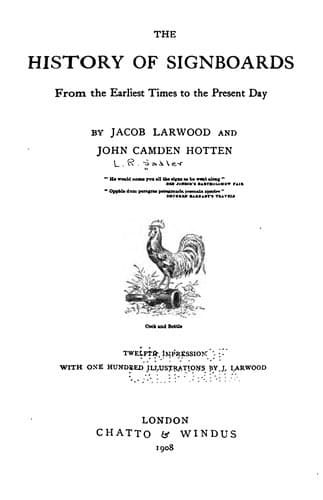
The History of Signboards, from the Earliest times to the Present DayHotten, John Camden
History
The History of Signboards, from the Earliest times to the Present Day
Hotten, John Camden
Inn signs -- England -- History; Signs and signboards -- History
In these modern days, the signboard is a very unimportant object: it was
not always so. At a time when but few persons could read and write,
house-signs were indispensable in city life. As education spread they
were less needed; and when in the last century, the system of numbering
houses was introduced, and every thoroughfare had its name painted at
the beginning and end, they were no longer a positive necessity--their
original value was gone, and they lingered on, not by reason of their
usefulness, but as instances of the decorative humour of our ancestors,
or as advertisements of established reputation and business success. For
the names of many of our streets we are indebted to the sign of the old
inn or public-house, which frequently was the first building in the
street--commonly enough suggesting its erection, or at least a few
houses by way of commencement. The huge “London Directory” contains the
names of hundreds of streets in the metropolis which derived their
titles from taverns or public-houses in the immediate neighbourhood. As
material for the etymology of the names of persons and places, the
various old signs may be studied with advantage. In many other ways the
historic importance of house-signs could be shown.
Something like a classification of our subject was found absolutely
necessary at the outset, although from the indefinite nature of many
signs the divisions “Historic,” “Heraldic,” “Animal,” &c.--under which
the various examples have been arranged--must be regarded as purely
arbitrary, for in many instances it would be impossible to say whether
such and such a sign should be included under the one head or under the
other. The explanations offered as to origin and meaning are based
rather upon conjecture and speculation than upon fact--as only in very
rare instances reliable data could be produced to bear them out.
Compound signs but increase the difficulty of explanation: if the road
was uncertain before, almost all traces of a pathway are destroyed here.
When, therefore, a solution is offered, it must be considered only as a
suggestion of the _possible_ meaning. As a rule, and unless the symbols
be very obvious, the reader would do well to consider the _majority_ of
compound signs as quarterings or combinations of others, without any
hidden signification. A double signboard has its parallel in commerce,
where for a common advantage, two merchants will unite their interests
under a double name; but as in the one case so in the other, no rule
besides the immediate interests of those concerned can be laid down for
such combinations.
Public-domain text, read in full here on John Shaqi.
Reviews
Reviews
No reviews yet
Be the first to share your thoughts on this work.
Join the Discussion
Join the discussion
Sign in to leave a comment or review.
Sign InorCreate an account