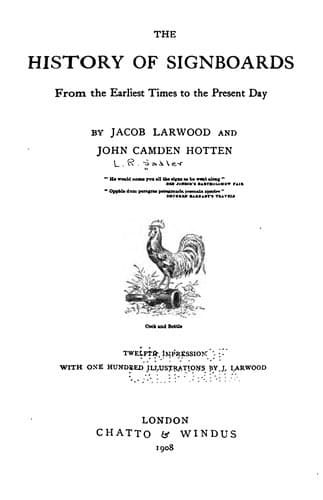
The History of Signboards, from the Earliest times to the Present DayHotten, John Camden
History
The History of Signboards, from the Earliest times to the Present Day
Hotten, John Camden
Inn signs -- England -- History; Signs and signboards -- History
From this and innumerable other similar advertisements, it appears that
pawnbrokers in those days did not always rigorously adhere to the Three
Balls; that is to say, they were occasionally goldsmiths, and in that
capacity used any sign.
It is rarely that the sign of the Cock designates any particular colour.
There is a BLACK COCK in Owen Street, Tipton; a cock of this colour was
always considered something more than an ordinary bird; with the Greeks
it was a grateful sacrifice to Esculapius and Pluto, and in the middle
ages it played a prominent part in matters of witchcraft. The BLUE COCK
is a sign at Leicester; but neither colour is common. At Hargrave, near
Bury St Edmunds, there is a COCK’S HEAD, put up either in imitation of a
nag’s,--bull’s,--bear’s,--or boar’s head, or as the crest of a fool’s
cap, which, in old times, usually terminated with a cock’s head.
Though some sort of religious prestige may at first have prompted the
choice of the cock, more profane ideas latterly contributed to make it
popular, such as the pastimes of cock-throwing, or “shying,” and
cock-fighting. To this first practice alludes the sign of William
Brandon, on Dowgate Hill, which was called, HAVE AT IT; his token
representing a man about to throw a stick at a cock. This cruel game was
very common in alehouses in former times; the whole sport consisting in
throwing a stick at an unfortunate cock tied to a stake; if the animal
was killed it was the thrower’s property; if not, he forfeited the small
sum paid for each “shy.” What a slaughter of cocks was carried on in
this way may be judged from the following:--
“Last Tuesday a Brewer’s servant in Southwark took his walk round
Towerhill, Moorfield, and Lincoln’s Inn Fields, and knocked down so
many cocks that by selling them again, he returned home twenty
shillings odd pence richer man than he came out.”[294]
Medals are extant of the reign of William III., on which John Bull is
represented throwing sticks at the French cock: not a very lofty
allegory, it must be confessed; but in those days the public taste was
not very refined; thus, after the victory of Blenheim, the simile was in
equal bad taste, the same idea being expressed by a huge lion tearing an
unfortunate cock in pieces.
Public-domain text, read in full here on John Shaqi.
Reviews
Reviews
No reviews yet
Be the first to share your thoughts on this work.
Elsewhere in the archive
Join the Discussion
Join the discussion
Sign in to leave a comment or review.
Sign InorCreate an account