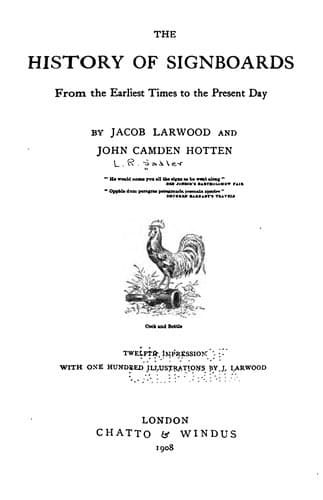
The History of Signboards, from the Earliest times to the Present DayHotten, John Camden
History
The History of Signboards, from the Earliest times to the Present Day
Hotten, John Camden
Inn signs -- England -- History; Signs and signboards -- History
The COCK AND TRUMPET is a common sign, typifying those ideas about the
cock expressed on p. 205. This simile is constantly used by the poets;
and most beautifully enlarged upon by Shakespeare:--
“The _Cock_ that is the _Trumpet_ of the morn,” &c.--_Hamlet_, a. i.
sc. 1.
“And now the _Cock_, the morning’s _trumpeter_,
Play’d hunt’s up to the day-star to appear.”--_Drayton._
“All the night shrill chaunticler,
Day’s Proclaiming _Trumpeter_,
Claps his wings and loudly cries,
Mortals, mortals, wake, arise.”--_Nativity Hymn._[296]
The COCK AND BELL, if not a simple combination of two signs, may be
derived from a custom formerly practised in some parts of England, for
boys to have cock-fights on Shrove Tuesday; the party whose cock won the
most battles, was held victorious in the cock-pit, and gained the
prize--a small silver _bell_ suspended to the button of the victor’s
hat, and worn for three successive Sundays. It is an old sign, and
occurs on a Birchin Lane trades token between 1648 and 1672.
The COCK AND BREECHES originated in a favourite form of gilt gingerbread
at Bartholomew Fair, although the very objectionable anecdote of Joe
Miller concerning such a sign is generally believed to have had
something to do with its origin.
The COCK AND BULL is still frequently seen, but though the meaning of
the phrase is well understood, neither its origin, nor the meaning of
the two animals on the signboard, have as yet been properly explained.
As we have no sound theory to offer, we shall abstain from entering on
the subject, for fear of giving an illustration of what a cock-and-bull
story is, rather than clearing up the mystery of the signboard. It
occurs amongst the seventeenth century trades tokens.
The COCK AND DOLPHIN was the sign of one of the London carriers’ inns:--
“James Nevil’s Coach to Hampstead comes to the Cock and Dolphin in
Gray’s Inn Lane, in and out every day.”--_De Laune’s Present State of
London_, 1681.
Hatton, in 1708, placed this inn “on the east side of Gray’s Inn Lane,
near the middle.” At the present day it is a public-house sign in
Kendal, Westmoreland. It is more likely to be a combination of two
signs, than to refer to the French Cock and the Dolphin in the arms of
the Dauphin. The same applies to the COCK AND ANCHOR in Gateshead and
Dublin; the COCK AND SWAN, and the COCK AND CROWN, both in Wakefield;
and the COCK AND BEAR at Nuneaton; whilst the COCK AND HOUSE in Norwich
may originally have been the cocking-house of the district,--that is,
the house where cock-fights were held.
Fully as general as the sign of the Cock is that of the SWAN; the reason
why, is perhaps truly, though coarsely, expressed under an old Dutch
signboard:--
“De Swaan voert ieder kroeg, zoowel in dorp als stad,
Om dat hy altyd graag is met de bek in ’t nat.”[297]
Public-domain text, read in full here on John Shaqi.
Reviews
Reviews
No reviews yet
Be the first to share your thoughts on this work.
Elsewhere in the archive
Join the Discussion
Join the discussion
Sign in to leave a comment or review.
Sign InorCreate an account