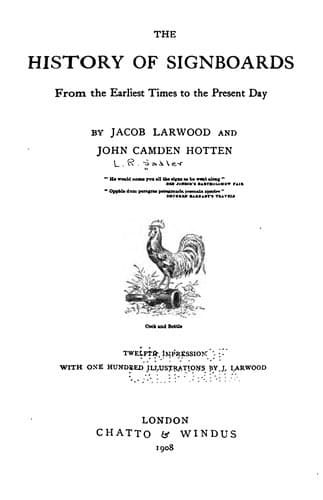
The History of Signboards, from the Earliest times to the Present DayHotten, John Camden
History
The History of Signboards, from the Earliest times to the Present Day
Hotten, John Camden
Inn signs -- England -- History; Signs and signboards -- History
Previous to 1598 there was a SWAN THEATRE on the Bankside, near the
Globe; so named from “a house and tenement called the Swan,” mentioned
in a charter of Edward VI., granting the manor of Southwark to the City
of London. It fell into decay in the reign of James I., was closed in
1613, and subsequently only used for gladiatorial exhibitions. Yet, in
its time, it had been well frequented, for a cotemporary author
says--“it was the Continent of the world, because half the year a world
of beauties and brave spirits resorted to it.” One of the oldest Swan
signs on record is that of the old printer, Wynkyn de Worde, assistant,
and finally successor to Caxton, who, in the beginning of the sixteenth
century, issued some works “emprynted at the signe of the Swane in
Fletestrete.”
From an anecdote preserved by Aubrey, iii. 415, it appears that Ben
Jonson did not always “go to the Devil,” but was also in the habit of
having his cup of sack at a Swan tavern near Charing Cross:--
“A GRACE BY BEN JONSON EXTEMPORE, BEFORE KING JAMES.
“Our king and queen, the Lord God blesse,
The Palsgrave and the Lady Besse,
And God blesse every living thing
That lives and breathes and loves the King.
God blesse the Councill of Estate,
And Buckingham the fortunate.
God blesse them all and keep them safe,
And God blesse me, and God bless Ralph.
“The king was mighty inquisitive to know who this Ralph was. Ben told
him ’twas the drawer at the Swanne Taverne by Charing-crosse, who drew
him good canarie. For this drollerie, his Ma^{tie} gave him an hundred
poundes.”
Tokens of this house of the plague year are extant, representing a Swan
with a sprig in its mouth, and the inscription, “Marke Rider at the Swan
against the Mewes,[299] 1665. His Halfe Penny.”
The Swan at Knightsbridge had a reputation which we should call “fast.”
It was well known to young gallants, and was the terror of all such
jealous husbands and fathers as the Sir David Dunce who figures in
Otway’s “Soldier of Fortune,” 1681:--
“I have surely lost and never shall find her more. She promised me
strictly to stay at home till I came back again; for ought I know, she
may be up three pairs of stairs in the Temple now, or it may be taking
the air as far as Knightsbridge with some smoothfaced rogue or
another; ’tis a damned house that Swan; that Swan at Knightsbridge is
a confounded house!”
Tom Brown also alludes to it; Peter Pindar (Dr Woolcot) commemorates a
vestry dinner there:--
“At Knightsbridge at a Tavern called the Swan,
Churchwardens, Overseers, a jolly clan,
Order’d a dinner for themselves,
A very handsome dinner,” &c.
The old house was pulled down in 1788, and its name transferred to a
public-house in Sloane Street, which, with three other houses, occupies
the site of the old Swan.
Public-domain text, read in full here on John Shaqi.
Reviews
Reviews
No reviews yet
Be the first to share your thoughts on this work.
Elsewhere in the archive
Join the Discussion
Join the discussion
Sign in to leave a comment or review.
Sign InorCreate an account