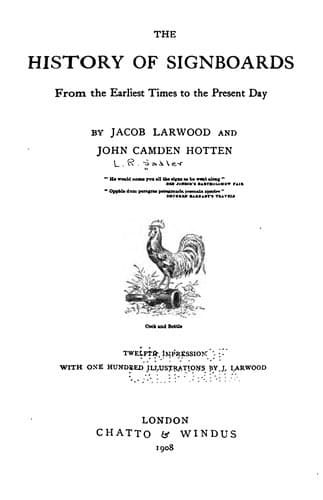
The History of Signboards, from the Earliest times to the Present DayHotten, John Camden
History
The History of Signboards, from the Earliest times to the Present Day
Hotten, John Camden
Inn signs -- England -- History; Signs and signboards -- History
As late as 1654, we find the name “maggoty pie” used in “Mercurius
Fumigosus, or the Smoking Nocturnal,” July 26 to August 3, where the
Welshman’s arms are described as a fly, a _maggoty pie_, &c.[311] The
MAGPIE AND STUMP represents the magpie sitting on the stump of a tree;
it was the sign of one of the Whig pothouses in the Old Bailey during
the riots of 1715. There is still an old house with such a sign in
Cheyne Walk, Chelsea. The MAGPIE AND PEWTER PLATTER, in Wood Street,
originated from a magpie standing by a dish and picking out of it. The
MAGPIE AND CROWN, says the author of “Tavern Anecdotes,” (1825,) is a
ridiculous association; but when once joined is not to be separated
without injury to the concern, as it happened in the case of a Mr
Renton, who was originally waiter at a house of this name in Aldgate,
famous for its ale, which was sent out in great quantities. The landlord
becoming rich, pride followed, and he thought of giving wing to the
Magpie, retaining only the royal attribute of the crown. The ale went
out for a short time, as usual, but it was not from the Magpie and
Crown, and the customers fancied it was not so good as usual;
consequently the business fell off. The landlord died, and Renton
purchased the concern, caught the Magpie, and restored it to its ancient
situation; the ale improved in the opinion of the public, and its
consumption increased so much, that Renton, at his death, left behind
him property amounting to £600,000, chiefly the profits of the Magpie
and Crown ale. This danger of altering a sign is also illustrated by
another example. When Joseph II., emperor of Germany, was at Maestricht,
in the Netherlands, he stayed at the GRAY ASS Inn, (_L’Ane Gris_,) in
honour of which imperial visit the landlord discarded his humble
quadruped sign, and put up the EMPEROR’S HEAD. The customers seeing the
Old Gray Ass gone, thought the business had fallen into other hands, and
so went to various inns in the neighbourhood, and particularly to a NEW
GRAY ASS, which had just then opened in the same street. The landlord
seeing his business falling off, through the change of his sign, yet
unwilling to part with his Emperor’s head, after long thinking and
pondering, at last hit upon a clever compromise: he kept up the portrait
of the Emperor, but wrote under it, “At the Original Gray Ass, (_au
veritable Ane Gris_.)”
The PARROT, or POPINJAY, is an old sign now almost out of fashion, the
GREEN PARROT, Swinegate, Leeds, being one of the few remaining. Andrew
Maunsell, a bookseller and printer, resided at the Parrot in St Paul’s
Churchyard in 1570, and continued to trade under this sign till 1600.
Taylor, the water poet, mentions the POPINJAY at Ewell, in 1636. It was
a very appropriate sign for quacks, and one of these, at all events, had
candour enough to adopt it. His handbill begins in a grandiloquent
style:--
Public-domain text, read in full here on John Shaqi.
Reviews
Reviews
No reviews yet
Be the first to share your thoughts on this work.
Elsewhere in the archive
Join the Discussion
Join the discussion
Sign in to leave a comment or review.
Sign InorCreate an account