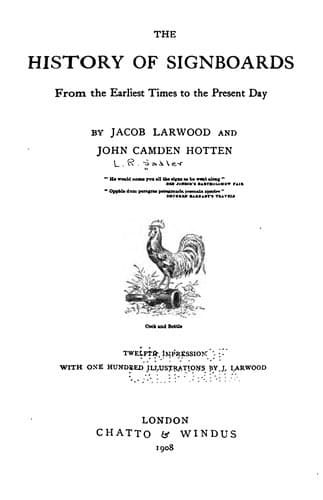
The History of Signboards, from the Earliest times to the Present DayHotten, John Camden
History
The History of Signboards, from the Earliest times to the Present Day
Hotten, John Camden
Inn signs -- England -- History; Signs and signboards -- History
“NOBLE or IGNOBLE, you may be foretold anything that may happen to
your Elementary Life: as at what time you may expect prosperity; or if
in Adversity the End thereof, or when you may be so happy as to enjoy
the Thing desired. Also young Men may foresee their Fortunes as in a
Glass, and pretty Maids their Husbands in this Noble, yea, Heavenlie
art of Astrologie. At the sign of the Parrot opposite to Ludgate
Church within Blackfriars’ Gateway.”[312]
The PARROT AND CAGE, in St Martin’s Lane, Strand, advertised in 1711 as
a “just and substantial office of insurance” on marriages, births, &c.
This office, apparently, had chambers in some bird-fancier’s house, at
all events to that class of the community the sign belonged more
exclusively. In 1787, there was one near the monument, the sign of a
cagemaker who sold “likewise parrots and other forring birds.”
The PEACOCK, in ancient times, was possessed of a mystic character. The
fabled incorruptibility of its flesh led to its typifying the
Resurrection; and from this incorruptibility, doubtless, originated the
first idea of swearing “by the Peacock,” an oath that was to be
inviolably kept. Its first introduction on the signboard is lost in the
unrecorded wastes of time; but the oath was a common one in early times,
especially on occasions of military adventures. Near the Angel in
Clerkenwell, there is the PEACOCK public-house, which bears the date
1564. This was formerly a great house of call for the mail and other
coaches travelling on the Great North Road, much the same as the
Elephant and Castle was for the southern counties. The PEACOCK AND
FEATHERS was a sign in Cornhill in 1711.
The OSTRICH seems more common at present than in ancient times. There is
one on a stone-carved sign in Bread Street, probably the sign of a
feather shop. Generally, the ostrich is represented with a horseshoe in
his mouth, in allusion to its digestive powers; for this reason Cade
says to Iden:--
“I’ll make thee _eat iron like an ostrich_, and swallow my sword like
a great pin.”--Henry VI., 2d Part, a. iv. sc. 10.
The landlord of an alehouse at Calverley, near Leeds, has put his
premises under the protection of Minerva’s bird, the OWL. At St Helens,
Lancashire, there is a still more curious sign, viz., the OWL’S NEST, or
the Owl in the Ivy Bush. A bush or tod of ivy was formerly supposed to
be a favourite place for the owl to make its nest in. The old dramatists
abound in allusions to this:
“And, like an owle, by night to go abroad,
Roosted all day within an ivy-tod.”[313]--_Drayton._
“Michael von Owle, how dost thou?
In what dark barn or _tod of aged ivy_
Hast thou been hid?”--_Beaumont and Fletcher_, a. iv. sc. 3.
Public-domain text, read in full here on John Shaqi.
Reviews
Reviews
No reviews yet
Be the first to share your thoughts on this work.
Elsewhere in the archive
Join the Discussion
Join the discussion
Sign in to leave a comment or review.
Sign InorCreate an account