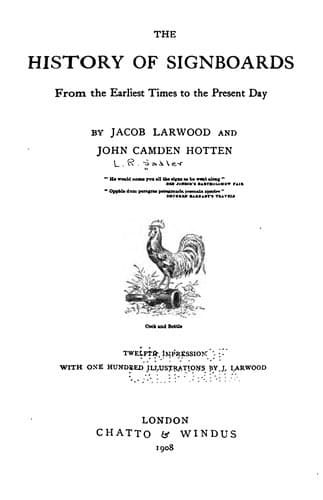
The History of Signboards, from the Earliest times to the Present DayHotten, John Camden
History
The History of Signboards, from the Earliest times to the Present Day
Hotten, John Camden
Inn signs -- England -- History; Signs and signboards -- History
In a masque of Shirley’s, entitled “The Triumph of Peace,” 1633, one of
the scenes represented a wild, woody landscape, “a place fit for
purse-taking,” where, “in the furthest part was seene an ivy-bush, out
of which came an owle.” _Opinion_, one of the _dramatis personæ_,
informed the public, that this scene was intended for “a wood, a
broad-faced owl, an ivy-bush, and other birds beside her.”[314]
In districts where GROUSE and MOORCOCK are found, these birds frequently
court the patronage of the thirsty sportsman at the village alehouse
door. One publican, at Upper Haslam, Sheffield, invites at once the
follower of Nimrod and of Walton: his sign is the GROUSE AND TROUT.
The last bird-sign which remains to be noticed, is unquestionably the
most puzzling of all. It occurs on an old trades token of Cornhill, and
is there called “THE LIVE VULTURE.” That the man should have kept a live
vulture at his door seems very improbable. The only explanation which
occurs to us, is the possibility that, at some period or other, a live
vulture had been exhibited at this house, and that from this event its
name was derived.[315]
A curious instance of a tradesman exhibiting a living bird as an
attraction to his house, is supplied us in a recent letter of a Paris
correspondent, which gives at the same time an amusing anecdote of the
well-known Alexandre Dumas. The writer, speaking of a magnificent new
café which had recently been completed, says:--
“Writing of this newly started restaurant naturally recals the fact of
the disappearance of the historic pavilion of Henry IV. at St
Germain-en-Laye, kept for many years by the Duchess of Berry’s _maître
d’hôtel_, Collinet. He was the pupil of Carême, and learnt to make
sauces from Richout, saucemaker to the last of the Condés, and pastry
from Heliot, “Ecuyer ordinaire de la bouche de Madame la Dauphine,” a
title I have vainly searched for in the list of the queen’s household.
The result of this combination of culinary instructions was that his
“Bifsteaks _à la Bearnaise_,” and his woodcock pies, attracted not
only all the fashionable world, but a brilliant galaxy of literary
celebrities to the “Pavilion Henry IV.” Alexandre Dumas’s château of
Monte Christo was close to St Germain. He sent daily for his cutlets
to Collinet, who let his bill run on till it amounted to 25,000f.
(£1000), in payment of which the distinguished _chef_ received an
autograph letter from the great novelist, accompanied by a _live
eagle_. Alexandre Dumas expressed his regret at not being able to pay
the bill, but suggested his _exhibiting the eagle_ and the letter,
which exhibition would inevitably attract crowds to his hotel, and
there I myself have seen the eagle and read the letter.”
[Illustration: PLATE X.
GREEN MAN.
(Roxburghe Ballads, circa 1650.)
ADAM AND EVE.
(Newgate Street, 1669.)
TOBACCONIST SIGN.
(Banks’s Collection, 1750.)
DOG’S HEAD IN POT.
(Roxburghe Ballads, 1665.)
Public-domain text, read in full here on John Shaqi.
Reviews
Reviews
No reviews yet
Be the first to share your thoughts on this work.
Elsewhere in the archive
Join the Discussion
Join the discussion
Sign in to leave a comment or review.
Sign InorCreate an account