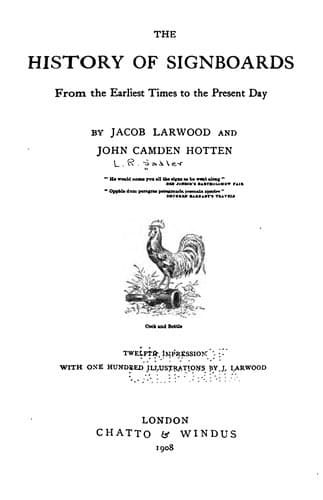
The History of Signboards, from the Earliest times to the Present DayHotten, John Camden
History
The History of Signboards, from the Earliest times to the Present Day
Hotten, John Camden
Inn signs -- England -- History; Signs and signboards -- History
WHISTLING OYSTER.
(Drury Lane, 1825.)]
[280] Coryatt’s Crudities, vol. i. p. 29.
[281] “Phisiologus tells us that the Pelican is very fond of his young
ones, and when they are born and begin to grow, they rebel in their nest
against their parent and strike him with their wings, flying about him
and beat him so much till they wound him in his eyes. Then the father
strikes again and kills them. And the mother is of such a nature that
she comes back to the nest on the third day and sits down upon her dead
young ones, and opens her side with her bill and pours her blood over
them, and so resuscitates them from death, for the young ones by their
instinct receive the blood as soon as it comes out of the mother, and
drink it.”--_Bibl. Nat. Belg._ No. 10074.
[282] _Notes and Queries_, No. 236, May 6, 1854.
[283] Letter of Memorial to King Charles II. from Sir John Hinton,
physician in ordinary to His Majesty, 1679. Ellis, Orig. Letters, 3d
series, vol. iii. p. 307.
[284] The _Three_ Blackbirds, Choughs, Crows, Ravens, &c., may allude to
Charles, James, and Rupert.
[285] Coryatt’s Crudities, vol. i. p. 39. In the East the same fable is
current as to the paternal affection of young storks; their name in
Hebrew is _chesadao_, which implies mercy or pity.
[286] “Armory of Byrdes, Imprynted at Londõ by John Wyght dwellĩg Poules
Church yarde at the sygne of the Rose.” A poem of the time of Henry
VIII., attributed to Skelton, the poet laureate.
[287] Bourne’s Observations on Popular Antiquities, 1725, p. 65.
[288] Aubrey’s Remains of Gentilisme and Judaism.--_Lansdown MSS._
[289] On the obverse:--
“When the cock began to crow
St Peter began to cry.”
Reverse:--
“The cock does not crow for nothing;
Ask St Peter, he can tell you.”
[290] Johnson’s Life of Lord Dorset.
[291] There was formerly a kind of ale called Cock ale, but what it was
is not exactly known.
[292] Meeting of Gallants at an Ordinarie. London, 1604. _Percy
Society_, 1841. Though this is a description of the state of London in
1603, it perfectly applies to the plague of 1665.
[293] The Art of Living in London. Poem in 2 cantos, 1768.
[294] _Protestant Mercury_, Feb. 14, 1700.
[295] _Daily Courant_, Aug. 9, 1711.
[296] Bisson’s Janus, or Small Tokens for the Old Year, and Little Gifts
for the New Year. 1674. Luttrell Ballads, vol. ii. p. 20.
[297] “The reason why so many alehouses in town and country have the
sign of the swan, is because that bird is so fond of liquid.”
[No English translation can convey the peculiar significance of the
original. The above gives only the bare sense.]
[298] J. T. Smith, Book for a Rainy Day, p. 280.
[299] The king’s stables (which stood on the site now occupied by
Trafalgar Square) called the “mews,” because formerly his majesty’s
falcons were kept there, _mue_ being a French word for a certain kind of
bird-cage or coop: whence the words “mewed up.”
Public-domain text, read in full here on John Shaqi.
Reviews
Reviews
No reviews yet
Be the first to share your thoughts on this work.
Elsewhere in the archive
Join the Discussion
Join the discussion
Sign in to leave a comment or review.
Sign InorCreate an account