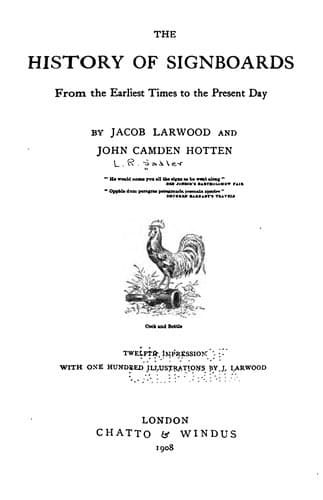
The History of Signboards, from the Earliest times to the Present DayHotten, John Camden
History
The History of Signboards, from the Earliest times to the Present Day
Hotten, John Camden
Inn signs -- England -- History; Signs and signboards -- History
In 1824, a mermaid or merman (for the sex was discreetly left _in
dubio_) made its appearance before “an enlightened public,” when, as the
papers inform us, “upwards of 150 distinguished fashionables” went to
see it. At Bartholomew Fair, in 1830, a stuffed mermaid was exhibited;
but if once she had been such a “mulier formosa” as captivated the
ancient mariners, she was certainly much altered.[317] A very different
specimen had been exhibited in Fleet Street in 1822; but she disappeared
all at once most mysteriously, not, however, without a rumour of her
being under the protection of the Lord Chancellor, which, as she was a
comely maiden with flaxen hair, “mulier superne _et inferne_,” lies
within the range of possibilities. The sea-serpent has now almost done
away with the mermaid; yet, as late as 1857, there appeared an article
in the _Shipping Gazette_, under the intelligence of 4th June, signed by
some Scotch sailors, and describing an object seen off the North British
coast, “in the shape of a woman, with full breast, dark complexion,
comely face,” and the rest.
At one time it appears to have been a very common sign, if we may judge
from the way in which it is mentioned by Brathwait in his New Cast of
Characters, (1631):--
“If she [the hostess] aspire to the conceit of a sine and device, her
birch pole pull’d downe, he will supply her with one, which he
performes so poorely as none that sees it, but would take it for a
_sign_ he was drunk when he made it. A long consultation is had before
they can agree what sign must be reared. ‘_A meere-mayde_’ says she,
‘for she will sing catches to the youths of the parish.’ ‘A lyon,’
says he, for that is the onely sign he can make; and this he formes so
artlessly, as it requires his expression, _this is a lyon_. Which old
Ellenor Rumming, his tapdame, denies, saying it should have been a
meere-mayde.”
Among the most celebrated of the Mermaid taverns in London, that in
Bread Street stands foremost. As early as the fifteenth century, it was
one of the haunts of the pleasure-seeking Sir John Howard, whose trusty
steward records, anno 1464:--“Paid for wyn at the Mermayd in Bred Stret,
for my mastyr and Syr Nicholas Latimer, x d. ob.” In 1603, Sir Walter
Raleigh established a literary club in this house, doubtless the first
in England. Amongst its members were Shakespeare, Ben Jonson, Beaumont
and Fletcher, Selden, Carew, Martin, Donne, Cotton, &c. It is frequently
alluded to by Beaumont and Fletcher in their comedies, but best known is
that quotation from a letter of Beaumont to Ben Jonson:--
Public-domain text, read in full here on John Shaqi.
Reviews
Reviews
No reviews yet
Be the first to share your thoughts on this work.
Elsewhere in the archive
Join the Discussion
Join the discussion
Sign in to leave a comment or review.
Sign InorCreate an account