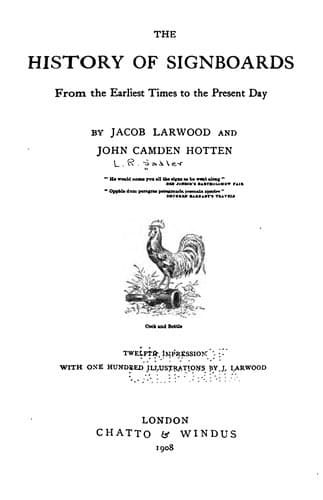
The History of Signboards, from the Earliest times to the Present DayHotten, John Camden
History
The History of Signboards, from the Earliest times to the Present Day
Hotten, John Camden
Inn signs -- England -- History; Signs and signboards -- History
“What things have we seen
Done at the Mermaid! heard words that have been
So nimble and so full of subtle flame,
As if that any one from whence they came
Had meant to put his whole wit in a jest,
And had resolved to live a fool the rest
Of his dull life; then when there hath been thrown
Wit able enough to justify the town
For three days past; wit that might warrant be
For the whole city to talk foolishly,
Till that were cancell’d; and when that was gone,
We left an air behind us, which alone
Was able to make the two next companies
(Right witty, though but downright fools) more wise.”
There was another Mermaid in Cheapside, frequented by Jasper Mayne, and
in the next reign by the poet laureate, John Dryden. Mayne mentions it
in “The City Match,” (1638:)--
“I had made an ordinary,
Perchance at the Mermaid.”
At one time the landlord’s name was Dun, which is told us in a somewhat
amusing anecdote:--“When Dun, that kept the Meremaid Tavern in Cornhill,
being himself in a room with some witty gallants, one of them (which, it
seems, knew his wife) too boldly cryd out in a fantastick humour, ‘I’ll
lay five pound there’s a cuckhold in this company.’ ‘’Tis _Dun_,’ says
another.”[318] In 1681, there was a Mermaid in Carter Lane, which had a
great deal of traffic as a carriers’ inn.[319]
The sign was also used by printers. John Rastall, for instance,
brother-in-law of Sir Thomas More, “emprynted in the Cheapesyde at the
sygne of the Meremayde; next to Poulysgate in 1527;” and in 1576 a
translation of the History of Lazarillo de Tormes, dedicated to Sir
Thomas Gresham, was printed by Henry Binnemann, the queen’s printer, in
Knight-rider Street, at the sign of the Mermaid. A representation of
this fabulous creature was generally prefixed to his books.
The SEAHORSE may be seen in Birmingham, York, and various other places.
Bossewell, in his peculiar mixture of English and Latin, gives a quaint
description of this animal:--
“This waterhorse of the sea is called an hyppotame, for that he is
like an horse in back, mayne, and neying: _rostro resupinato a primis
dentibus: cauda tortuosa, ungulis binis_. He abideth in the waters on
the day, and eateth corn by night _et hunc Nilus gignit_.”[320]
The DOLPHIN is another sign of very old standing. One of the first
instances of its use was probably the following inn:--
“The other side of this High Street, from Bishopsgate and Houndsditch,
the first building is a large inn for the receipt of travellers, and
is called the Dolphin, of such a sign. In the year 1513, Margaret
Ricroft, widow, gave this house, with the gardens and appurtenances,
unto William Gam, R. Clye, their wives, her daughters, and to their
heirs, with condition they yearly do give to the warders or govornors
of the Greyfriars’ Church, within Newgate, 40 shillings, to find a
student of divinity in the university for ever.”[321]
Public-domain text, read in full here on John Shaqi.
Reviews
Reviews
No reviews yet
Be the first to share your thoughts on this work.
Elsewhere in the archive
Join the Discussion
Join the discussion
Sign in to leave a comment or review.
Sign InorCreate an account