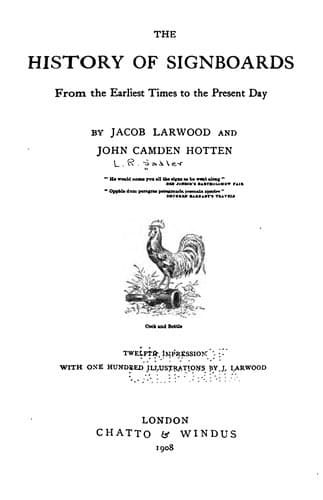
The History of Signboards, from the Earliest times to the Present DayHotten, John Camden
History
The History of Signboards, from the Earliest times to the Present Day
Hotten, John Camden
Inn signs -- England -- History; Signs and signboards -- History
Moser, in his “Vestiges Revived,” mentions this same inn as the Dolphin,
or rather, Dauphin Inn; and says that it was adorned with fleur-de-lys,
cognisances, and dolphins; and was reported to have been the residence
of one of the dauphins of France, probably Louis, the son of Philip
August, who, in 1216, came to England to contest the sceptre with King
John.[322] The house was still in existence at the end of the
seventeenth century, when it was a famous coaching inn. Perhaps it was
to this tavern that Pepys and his company adjourned on 27th March
1661:--
“To the Dolphin to a dinner of Mr Harris’s, where Sir William and my
Lady Batten and her two daughters, and other company, when a great
deal of mirth, and there staid till 11 o’clock at night, and in our
mirth I sang and sometimes fiddled, (there being a noise of fiddlers
there,) and at last we fell to dancing, the first time that ever I did
in my life, which I did wonder to see myself to do. At last we made
Mingo, Sir W. Batten’s black, and Jack, Sir W. Penn’s, dance, and it
was strange how the first did dance with a great deal of skill.”
Pepys might well wonder what a man may come to, he who had been born
when “lascivious dancing” was considered a heinous crime. Another
Dolphin, well worthy of remembrance, was the sign of Sam. Buckley, a
bookseller in Little Brittain, at whose house Steele and Addison’s
_Spectator_ was published.
Ancient naturalists made a wonderful animal of the dolphin. Bossewell,
for instance, from whom we have just quoted, tells most extraordinary
stories about him; but they are unfortunately too long to quote.
Londoners formerly might have seen the living fish from the river banks,
for old chroniclers every now and then have entries to the effect that
dolphins paid London a visit. Thus: “3 Henry V. Seven dolphins came up
the river Thames, whereof 4 were taken.” “14 Rich. II. On Christmas day
a dolphin was taken at London Bridge, being 10 ft. long, and a monstrous
grown fish.”[323] The DOLPHIN AND ANCHOR is still a common sign; and the
FISH AND ANCHOR, at North Littleton, Warwickshire, evidently implies the
same emblem. Aldus Manutius, the celebrated Venetian printer, was the
first to use the sign, adopting it from a silver medal of the Emperor
Titus, presented to him by Cardinal Bembo, with the motto, σπευδε
βραδεως. Camerarius thus (in our translation) mentions this sign in his
book on Symbols:--
“That the dolphin wound round the anchor was an emblem of the Emperors
August and Titus, to represent that maturity in business which is the
medium between too great haste and slowness; and that it was also used
in the last century by Aldus Manutius, that most famous printer, is
known to everybody. Erasmus clearly and abundantly explains the import
of that golden precept.
Public-domain text, read in full here on John Shaqi.
Reviews
Reviews
No reviews yet
Be the first to share your thoughts on this work.
Elsewhere in the archive
Join the Discussion
Join the discussion
Sign in to leave a comment or review.
Sign InorCreate an account