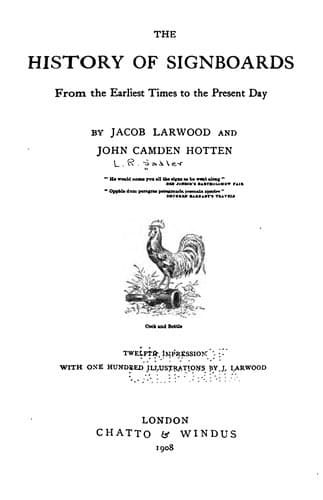
The History of Signboards, from the Earliest times to the Present DayHotten, John Camden
History
The History of Signboards, from the Earliest times to the Present Day
Hotten, John Camden
Inn signs -- England -- History; Signs and signboards -- History
“Our emblem is taken from Alciatus, and has a different meaning. He
reports, namely, that ‘when violent winds disturb the sea, as
Lucretius says, and the anchor is cast by seamen, the dolphin winds
herself round it, out of a particular love for mankind, and directs
it, as with a human intellect, so that it may more safely take hold of
the ground; for dolphins have this peculiar property, that they can,
as it were, foretell storms. The anchor, then, signifies a stay and
security, whilst the dolphin is a hieroglyphic for philanthropy and
safety.’”--_Joach. Camerarius_, “_Symbolorum et Emblematum Centuriæ
Quatuor_.” _Centuria_ iv. p. 19; _Moguntia_, 1697.
This sign was afterwards adopted by William Pickering, a worthy
“Discipulus Aldi,” as he styled himself; Sir Egerton Bridges made some
verses upon it, amongst which occur the following:--
“Would you still be safely landed,
On the Aldine _Anchor_ ride;
Never yet was vessel stranded,
With the Dolphin by its side.
* * * * *
“Nor time, nor envy ever shall canker
The sign that is my lasting pride;
Joy then to the Aldus Anchor,
And the Dolphin at its side.
“To the Dolphin as we ‘re drinking,
Life and health and joy we send;
A poet once he saved from sinking,
And still he lives--the poet’s friend.”
The DOLPHIN AND COMB was the sign of E. Herne, a milliner on London
Bridge in 1722. This is an instance of one of the articles sold within
being added to the original sign of the house. Milliners in those days
used to have a much more extensive variety of objects for sale than they
have now, comprehending almost every article required for female
apparel,--and including knives, scissors, combs, pattens, patches,
poking sticks, fans, bodkins, &c. Such additions to signs were of
frequent occurrence, thus the Fox and Topknot, the Lamb and Breeches,
the Fox and Cap, and the LAMB AND INKBOTTLE, which last figures on the
imprint of Thomas Roch, Newgate Street, a bookseller who made “the best
ink for deeds and records,” 1677. Frequently the sign of the Fish is
seen without any further specification; in this case it is probably
meant for the Dolphin, which is the signboard-fish _par excellence_. The
Fish sign is a very common public house decoration at the present day,
probably for the same reason as the Swan, because he is fond of
liquor,--nay, to such an extent goes his reputation for intemperance,
that to “drink like a fish” is a quality of no small excellence with
publicans. In Carlisle, however, there are two signs of the FISH AND
DOLPHIN, a rather puzzling combination,--unless it has reference to the
dolphin’s chase after the shoals of small fishes. The FISH AND BELL,
Soho, may either allude to a well-known anecdote of a certain numskull,
who, when he caught a fish, which he desired to keep for dinner on some
future grand occasion, put it back into the river, with a bell round its
Public-domain text, read in full here on John Shaqi.
Reviews
Reviews
No reviews yet
Be the first to share your thoughts on this work.
Elsewhere in the archive
Join the Discussion
Join the discussion
Sign in to leave a comment or review.
Sign InorCreate an account