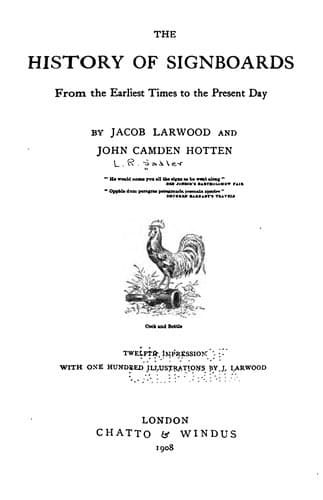
The History of Signboards, from the Earliest times to the Present DayHotten, John Camden
History
The History of Signboards, from the Earliest times to the Present Day
Hotten, John Camden
Inn signs -- England -- History; Signs and signboards -- History
neck, so that he should be able to know its whereabouts the moment he
wanted it; or it may be the usual Bell added in honour of the
bell-ringers. A quaint variety of this sign is the BELL AND MACKEREL, in
the Mile-End Road. The THREE FISHES was a favourite device in the Middle
Ages, crossing or interpenetrating each other in such a manner, that the
head of one fish was at the tail of another. We cannot prove that it had
any emblematic meaning, but it may possibly represent the Trinity, the
fish being a common symbol for Christ, derived from the Greek monogram
or abbreviation, ΙΧΘΥΣ. It occurs as a sign in the following
advertisement, which minutely describes the livery of a page in the year
of the Restoration:--
“On Saturday night last run away from the Lord Rich, Christophilus
Cornaro, a Turk christened; a French youth of 17 or 18 years of age,
with flaxen hair, little blew eyes, a mark upon his lip, and another
under his right eye; of a fair complexion, one of his ears pierced,
having a pearl-coloured suit, trimmed with scarlet and blue ribbons, a
coat of the same colour with silver buttons; his name Jacob David.
Give notice to the Lord, lodging at the Three Fishes in New Street, in
Covent Garden, a cook-shop, and good satisfaction shall be
given.”[324]
THE THREE HERRINGS, the sign of James Moxton, a bookseller in the
Strand, near Yorkhouse, in 1675, is evidently but another name for the
Three Fishes; at the present day it is the sign of an ale-house in Bell
Yard, Temple Bar. Several taverns with this sign are mentioned in the
French tales and plays of the 17th century; two of them seem to have
been very celebrated, one in the Faubourg St Marceau, the other near the
Palais de Justice; this last one seems to have been particularly
famous, for it is named as a rival to the celebrated Pomme de Pin. “Si
je vay au Palais, tous ces clercs sont alentour de moy; l’un me mène aux
Trois Poissons, l’autre à la Pomme de Pin.”--Comédie de la Vefve, ac.
iii. s. 3.[325] The FISH AND QUART at Leicester must be passed by in
silence, as the combination cannot immediately be accounted for. Were it
in France a solution would be easier, for in French slang a “poisson,”
or fish, means a small measure of wine. The FISH AND EELS at Roydon, in
Essex; the FISH AND KETTLE, Southampton; and the WHITE BAIT, Bristol,
all tell their own tale, and need no comment. The SALMON is seen
occasionally near places where it is caught. The SALMON AND BALL is the
well-known Ball of the silkmercers in former times, added to the sign of
the Salmon; whilst the SALMON AND COMPASSES is the masonic emblem that
is added to the sign. Both these occur in more than one instance in
London. The FISHBONE is rarely met with as a public-house sign, though
there is an example of it at Netherton in Cheshire, and also amongst the
seventeenth century tokens of New Cheapside, Moorfields. But generally
it is the sign of a rag and bone shop, or, in the euphonious language of
Public-domain text, read in full here on John Shaqi.
Reviews
Reviews
No reviews yet
Be the first to share your thoughts on this work.
Elsewhere in the archive
Join the Discussion
Join the discussion
Sign in to leave a comment or review.
Sign InorCreate an account