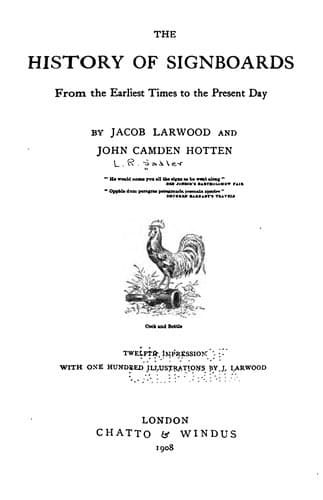
The History of Signboards, from the Earliest times to the Present DayHotten, John Camden
History
The History of Signboards, from the Earliest times to the Present Day
Hotten, John Camden
Inn signs -- England -- History; Signs and signboards -- History
Not only fruit-trees but various forest-trees are constantly met with on
the signboard: thus the GREEN TREE, which is very common, originally had
allusion to the foresters of the “merry greenwood,” or was suggested by
some large evergreen, or tree sheltering, or standing near the inn; of
this green tree the GREEN SEEDLING in Chester is evidently a sprout.
Again, in Sheffield there are two signs of the BURNT TREE, which name
possibly originated from some tree having been damaged in a fire, and
becoming a well-known landmark. The OAK, the vigorous emblem of our
mighty state, is deservedly much used for a sign; sometimes it is called
the BRITISH OAK. At Kilpeck, in Herefordshire, the following rhyme
accompanies it:--
“I am an oak and not a yew,
So drink a cup with good John Pugh.”
Druidical recollections are called up by the OAK AND IVY, at Bilston,
Stafford; HEARTS OF OAK is the material out of which, according to the
song, our ships and seamen are constructed, and therefore well deserves
the favourite place it occupies amongst the signboards of the present
day; whilst the ACORN, the fruit of the British oak, is nearly as common
as the other oak signs.
Next to the oak the ELM seems to have had most followers. From the
trades tokens it appears that the THREE ELMS was the sign of Edward
Boswell in Chandos Street, in 1667; and also of Isaac Elliotson, St John
Street, Clerkenwell. Besides these there was, about the same date, the
ONE ELM, and the ELM. At present we have the NINE ELMS, and the QUEEN’S
ELM, Brompton, which is mentioned under the name of the QUEEN’S TREE, in
the parish books of 1586. This tree is said to derive its name from the
fact of Queen Elizabeth, when on a visit to Lord Burleigh, being caught
in a shower of rain, and taking shelter under the branches of an
elm-tree, then growing on this spot. The SEVEN SISTERS, the sign of two
public-houses in Tottenham, were seven elm-trees, planted in a circular
form, with a walnut tree in the middle; they were upwards of 500 years
old, and the local tradition said that a martyr had been burnt on that
spot. They stood formerly at the entrance from the high road at Page
Green, Tottenham. Within the last twenty years they have been removed.
The CHESTNUT, the SYCAMORE, the BEECH TREE, the FIR TREE, the BIRCH
TREE, and the ASH TREE, all occur in various places where ale-houses are
built in the shadow of such trees. The THORN TREE is peculiar to
Derbyshire. The BUCKTHORN TREE was, in 1775, the sign of “William
Blackwell in Covent Garden, or at his garden in South Lambeth.” He had
chosen this sign because he sold, amongst other herbs, “_buckthorn_ and
elder-berries, besides leeches and _vipers_.” What the use of the first
was is well known; as for the vipers, they were eaten in broth and
soups, before Madame Rachel’s enamels were employed, by ladies who
wished to continue “young and beautiful for ever.” The CRAB TREE, our
indigenous apple-tree, is also seen in a great many places. A house in
Public-domain text, read in full here on John Shaqi.
Reviews
Reviews
No reviews yet
Be the first to share your thoughts on this work.
Elsewhere in the archive
Join the Discussion
Join the discussion
Sign in to leave a comment or review.
Sign InorCreate an account