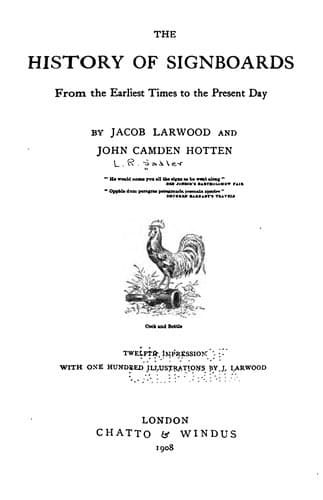
The History of Signboards, from the Earliest times to the Present DayHotten, John Camden
History
The History of Signboards, from the Earliest times to the Present Day
Hotten, John Camden
Inn signs -- England -- History; Signs and signboards -- History
Fulham, with that name, is well known to the oarsmen on the Thames. It
derives its denomination from a large crab-tree growing near the
public-house, which gave its name to the whole village. The WILLOW TREE
is very rare; in the seventeenth century it was the sign of a shop in
the Old Exchange, as appears from a trades token, but what business was
carried on under this gloomy sign does not appear. Fuller, in his
Worthies, (_voce_ Cambridgeshire,) says of willows:--
“A sad tree whereof such who have lost their love make them mourning
garlands; and we know that exiles hung their harps upon such doleful
supporters; the twiggs hereoff are physick to drive out the folly of
children. Let me add that if green ash may burn before a queen,
withered willows may be allowed to burn before a lady.”
As an attribute of forsaken love it is of constant occurrence in old
plays:--
“_Sylli._ If you forsake me,
Send me word, that I may provide a _willow garland_
To wear when I drown myself.”
MASSINGER’S _Maid of Honour_, a. iv. s. 5, 1631.
And in the same play Sylli, who thinks himself the preferred lover, says
to his rival:--
“You may cry willow, willow!”--_Ibid._, a. v. s. 1.
Shakespeare uses the same emblem frequently, particularly in Desdemona’s
famous willow song. There is a quaint ballad which an old Northumberland
woman used to sing, but which we have never seen in print: it begins as
follows:--
“Young men are false, and they are so deceitful:
Young men are false, and they seldom will prove true;
For wi’ wrangling and jangling, their minds are always changing,
They’re always seeking for some pretty girl that’s new.
It’s all round my hat, I will wear a green willow,
It’s all round my hat for a twelvemonth and a day;
If any one should ask you the reason why I wear it,
Oh! tell them I have been slighted by my own true love.”
Douce, in his “Illustrations to Shakespeare,” says:--This tree might
have been chosen as the symbol of sadness from the verse in Psalm
cxxxvii.: “We hanged our harps upon the willows in the midst thereof;”
or else from a coincidence between the weeping willow and falling tears.
Another reason has been assigned: the _Agnus castus_ or _vitex_ was
supposed by the ancients to promote chastity, “and the willow being of a
much like nature,” says an old writer, “it is yet a custom that he which
is deprived of his love must wear a willow garland.”--_Swan’s Speculum
Mundi_, ch. vi. sec. 4. 1635.
Public-domain text, read in full here on John Shaqi.
Reviews
Reviews
No reviews yet
Be the first to share your thoughts on this work.
Elsewhere in the archive
Join the Discussion
Join the discussion
Sign in to leave a comment or review.
Sign InorCreate an account