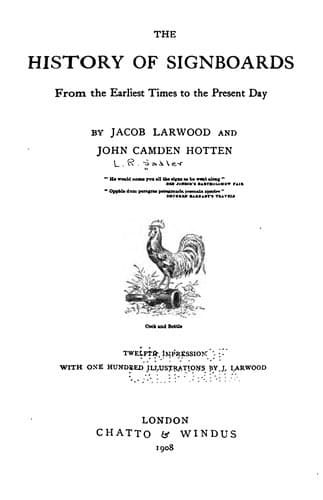
The History of Signboards, from the Earliest times to the Present DayHotten, John Camden
History
The History of Signboards, from the Earliest times to the Present Day
Hotten, John Camden
Inn signs -- England -- History; Signs and signboards -- History
“The use of coffee-houses seems newly improved by a new invention
called Chocolate-houses, for the benefit of rooks and cullies of all
the quality, where gaming is added to all the rest, and the summons of
wh---- seldom fails: as if the devil had erected a new university, and
those were the colleges of its professors, as well as his school of
discipline.”[358]
Chocolate was known in Germany as early as 1624, when Joan Franz. Rauch
wrote a treatise against that beverage and the monks. In England,
however, it seems to have been introduced much later, for in 1657 it was
advertised as a new drink:--
“IN BISHOPSGATE STREET, in Queen’s Head Alley, at a Frenchman’s house,
is an excellent West India drink called Chocolate to be sold, where
you may have it ready at any time, and also unmade, at reasonable
rates.”[359]
It is amusing to observe the fluctuating reputation of chocolate on its
first introduction. M^{me}. de Sévigné, in her letters, gives many
proofs of it; at one time she fervently recommends it to her daughter as
a perfect panacea, at other times she is as violently against it, and
puts it down as the root of all evil.
THE COFFEE HOUSE is the now inappropriate sign of a gin-palace in
Chalton Street, Somers Town. Early in the last century this
neighbourhood was a delightful rural suburb, with fields and flower
gardens. A short distance down the hill was the then famous Bagnigge
Wells, and close by were the remains of Totten-Hall, with the Adam and
Eve tea-gardens, and the so-called King John’s Palace. Many foreign
Protestant refugees had taken up their residence in this suburb, on
account of the retirement it afforded, and the low rates asked for the
small houses. “THE COFFEE HOUSE” was then the popular tea and
coffee-gardens of the district, and was visited by the foreigners of the
neighbourhood, as well as the pleasure-seeking Cockney from the distant
city. There were other public-houses and places of entertainment near at
hand, but the specialty of this establishment was its coffee. As the
traffic increased, it became a posting-house, uniting the business of an
inn to the profits of a pleasure garden. Gradually the demand for coffee
fell off, and that for malt and spirituous liquors increased. At present
the gardens are all built over, and the old gateway forms part of the
modern bar; but there are aged persons in the neighbourhood who remember
Sunday-school excursions to the place, and pic-nic parties from the
crowded city, making merry here in the grounds.
Public-domain text, read in full here on John Shaqi.
Reviews
Reviews
No reviews yet
Be the first to share your thoughts on this work.
Elsewhere in the archive
Join the Discussion
Join the discussion
Sign in to leave a comment or review.
Sign InorCreate an account