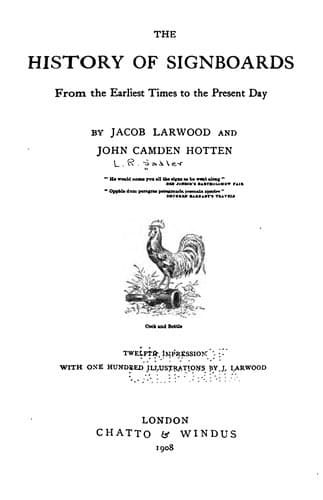
The History of Signboards, from the Earliest times to the Present DayHotten, John Camden
History
The History of Signboards, from the Earliest times to the Present Day
Hotten, John Camden
Inn signs -- England -- History; Signs and signboards -- History
In London, however, the use of this sign may at first have been
suggested by the statues of Moses and Aaron that used to stand above the
balcony of the Old Guildhall. Connected with the history of Moses, we
find several other signs, one in particular, mentioned by Ned Ward as
the OLD PHARAOH in the town of Barley, in Cambridgeshire. It was so
named, says he, “from a stout, elevating malt liquor of the same name,
for which this house had been long famous.”[379] Why this beer was
called Pharaoh, Ned Ward does not seem to have known; but a story in the
county is current that it was so named because the beer, like the
Egyptian king of old, “would not let the people go!” It is now no longer
drunk in England, but a certain strong beer of the same name is still a
favourite beverage in Belgium. Next, in chronological order, connected
with the history of Moses, follows the BRAZEN SERPENT, the sign of
Reynold Wolfe, a bookseller and printer in St Paul’s Churchyard, 1544,
and also of both his apprentices, Henry Binneman and John Shepperde. It
had probably been imported by the foreign printers, for it was a
favourite amongst the early French and German booksellers. At the
present day it is a public-house sign in Richardson Street, Bermondsey.
What led to the adoption of this emblem was not the historical
association, but the mystical meaning which it had in the middle ages:--
“A serpent torqued with a long cross; others blazon Christ, supporting
the brazen serpent, because it was an anti-type of the passion and
death of our Saviour; for as Moses lifted up the serpent in the
wilderness, so must the Son of Man be lifted up, (Num. xxi. 8, 9; John
iii. 14,) that all that behold him, by a lively faith, may not perish,
but have everlasting life. This is the cognizance or crest of every
true believer.”[380]
The idea was no doubt borrowed from the Biblia Pauperum. The BALAAM’S
ASS, again, was one of the _dramatis personæ_ in the Whitsuntide mystery
of the company of cappers, (cap-makers,) and this is the only reason we
can imagine for his having found his way to the signboard. It occurs in
1722 in a newspaper paragraph, concerning a child born without a
stomach, the details of which are too nauseous to be introduced
here.[381]
The TWO SPIES is the last sign belonging to the history of Moses; it
represents two of the spies that went into Canaan, “and cut down from
thence a branch with one cluster of grapes, and they bare it between two
upon a staff,” (Num. xiii. 23.) This bunch of grapes made it a favourite
with publicans; at many places it may still be seen, as in Catherine
Street, Strand, (a house of old standing;) in Long Acre, &c. In Great
Windmill Street, Leicester Square, it has been corrupted into the THREE
SPIES.
Public-domain text, read in full here on John Shaqi.
Reviews
Reviews
No reviews yet
Be the first to share your thoughts on this work.
Elsewhere in the archive
Join the Discussion
Join the discussion
Sign in to leave a comment or review.
Sign InorCreate an account