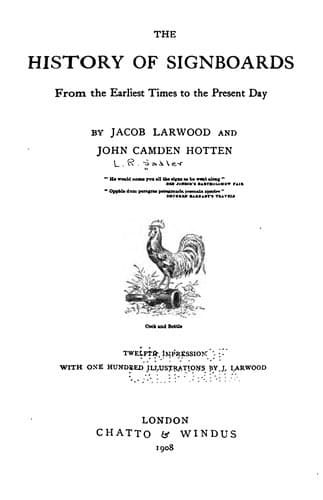
The History of Signboards, from the Earliest times to the Present DayHotten, John Camden
History
The History of Signboards, from the Earliest times to the Present Day
Hotten, John Camden
Inn signs -- England -- History; Signs and signboards -- History
There being, then, such a profusion of Angels everywhere, it became
necessary to make some distinctions, and the usual means were adopted;
the Angel was gilded, and called the GOLDEN ANGEL; this, for instance,
was the sign of Ellis Gamble, a goldsmith in Cranbourn Alley, Hogarth’s
master in the art of engraving on silver; shop-bills engraved for this
house by Hogarth are still in existence. Another variety was the
GUARDIAN ANGEL, which is still the sign of an ale-house at Yarmouth.
This, too, was used in France, as we find _l’Ange Gardien_, the sign of
Pierre Witte, a bookseller in the Rue St Jacques, Paris, in the
seventeenth century.
Very common, also, were the THREE ANGELS, which may have been intended
for the three angels that appeared to Abraham, or simply the favourite
combination of three,[390] so frequent on the signboard and in
heraldry. That three angels were thought to possess mysterious power, is
evident from the following Devonshire charm for a burn:--
“Three Angels came from the north, east, and west,
One brought fire, another ice,
And the third brought the Holy Ghost,
So out fire--and in frost--
In the name of Father, Son, and Holy Ghost.”
The THREE ANGELS was a very general linen-draper’s sign, for which there
seems no reason other than that the long flowing garments in which they
are generally represented, suggest their having been good customers to
the drapery business.
Angels appear in combination with various heterogenous objects, in many
of which, however, the so-called Angel is simply a Cupid. The ANGEL AND
BIBLE was a sign in the Poultry in 1680.[391] The ANGEL AND CROWN was a
not uncommon tavern decoration. The following stanza from a pamphlet,
entitled, “The Quack Vintners,” London, 1712, p. 18, shows the way in
which this sign was represented:--
“May Harry’s ANGEL be a sign he draws
Angelick nectar, that deserves applause,
Such that may make the city love the Throne,
And, like his _Angel_, still _support the Crown_.”
From this we learn it was a Cupid or Amorino supporting a crown; the
sign of the house had doubtless originally been the Crown, and the
Cupid, so common in the Renaissance style, had been added by way of
ornament, but was mistaken by the public as a constituent of the sign.
The verses probably applied to the Angel and Crown, a famous tavern in
Broad Street, behind the Royal Exchange. There was another ANGEL AND
CROWN in Islington, where convivial dinners were held in the olden time.
It was a common practice in the last and preceding centuries for the
natives of a county or parish to meet once a year and dine together. The
ceremony often commenced by a sermon, preached by a native, after which
the day was spent in pleasant conviviality, after-dinner speeches, and
mutual congratulations. The custom now has almost died out; but this is
one of the invitation tickets:
ST MARY, ISLINGTON.
SIR,
Public-domain text, read in full here on John Shaqi.
Reviews
Reviews
No reviews yet
Be the first to share your thoughts on this work.
Elsewhere in the archive
Join the Discussion
Join the discussion
Sign in to leave a comment or review.
Sign InorCreate an account