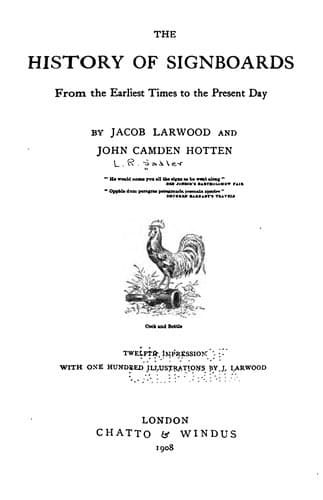
The History of Signboards, from the Earliest times to the Present DayHotten, John Camden
History
The History of Signboards, from the Earliest times to the Present Day
Hotten, John Camden
Inn signs -- England -- History; Signs and signboards -- History
You are desidered to meet many other NATIVES of this place on Tuesday
y^{e} 11th day of April 1738 at Mrs Eliz. Grimstead’s y^{e} ANGEL AND
CROWN, in y^{e} Upper Street, about y^{e} hour of One; Then and there
w^{th} FULL DISHES, GOOD WINE AND GOOD HUMOUR to improve and make
lasting that HARMONY and FRIENDSHIP which have so long reigned among
us.
_Walter Sebbon._
_John Booth._
_Bourchier Durrell._
_James Sebbon._
STEWARDS.
N.B. THE DINNER will be on the table peremptorily at Two.
_Pray pay the Bearer Five Shillings._
That same year, another Angel and Crown Tavern in Shire Lane obtained an
unenviable notoriety, for it was there that a Mr Quarrington was
murdered and robbed by Thomas Carr, an attorney from the Temple, and
Elisabeth Adams. They were hanged at Tyburn, January 18, 1738.
The ANGEL AND GLOVES at first sight seems a whimsical combination, but
is easily explained when we advert to the woodcut above the shop-bill of
Isaac Dalvy, in Little Newport Street, Soho, who, in the reign of Queen
Anne, sold gloves, &c., under this sign, which simply represented two
Cupids, each carrying a glove,--in fact, exactly the same conceit as
that of the Herculanese shoemaker, noticed in a former chapter. It is
more difficult to find a rational explanation for the ANGEL AND
STILLIARDS. The Steelyard, or Stilliard, in Upper Thames Street, was the
place where the Hanse merchants exposed their goods for sale, and was so
called from the king’s _steelyard_, or _beam_, there erected for
weighing the tonnage of goods imported into London.[392] Whether this
sign represented a Cupid with such a weighing machine, or a view of the
hall of the Hanse merchants, with a Fame flying over it, is now
impossible to decide. It may be suggested that a variation of the
well-known figure of Justice, with steelyards in place of the usual
scales, was the origin. Be this as it may, the only mention we have
found of the sign is in the following advertisement:--
“William Deval, at the ANGEL & STILLIARDS, in St Ann’s Lane, near
Aldersgate, London, maketh Castle (Castille), Marble, and white Sope
as good as any Marseilles Sope; Tryed and Proved and sold at very
Reasonable Rates.”[393]--_Domestic Intelligencer_, January 2d, 1679.
A few years later we find the ANGEL AND STILL noticed, as in the
following advertisement:--
“A well-set NEGRO, commonly called Sugar, aged about twenty years,
teeth broke before, and several scars in both his cheeks and forehead,
having absented from his Master, whosoever secures him and gives
notice to Benjamin Maynard, at the ANGEL AND STILL, at Deptford, shall
have a Guinea Reward and reasonable charges.”--_Weekly Journal_,
October 18, 1718.
In this case the still was simply added to intimate the sale of
spirituous liquors.
Public-domain text, read in full here on John Shaqi.
Reviews
Reviews
No reviews yet
Be the first to share your thoughts on this work.
Elsewhere in the archive
Join the Discussion
Join the discussion
Sign in to leave a comment or review.
Sign InorCreate an account