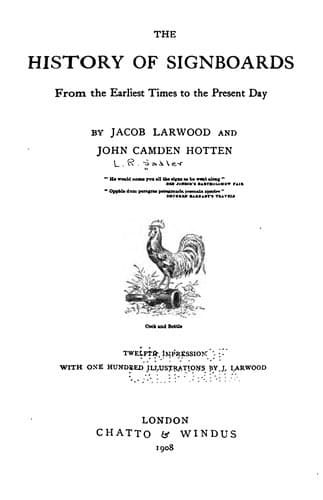
The History of Signboards, from the Earliest times to the Present DayHotten, John Camden
History
The History of Signboards, from the Earliest times to the Present Day
Hotten, John Camden
Inn signs -- England -- History; Signs and signboards -- History
And in the story of “L’Anneau,” by Jean de Boves, (which is the same as
Chaucer’s “Miller’s Tale,”) it is said of the two students at the
end:--“C’est ainsi qu’ils eûrent à ses depens l’ostel Saint
Martin.”[412] These two saints, it is believed, are no longer to be
found on the signboard, but another powerful patron of travellers, ST
CHRISTOPHER, may still occasionally be met with, as for instance in
Bath, where in the seventeenth century it was still very common. Taylor
the Water poet mentions it as the sign of an inn at Eton, and it occurs
on various trades tokens of London shops, inns, and taverns. This
saint’s intercession was thought efficacious against all danger from
fire, flood, and earthquake, whence it became a custom to paint his
image of a colossal size on walls of churches and houses, sometimes
occupying the whole height of the building, so that it might be seen
from a great distance. Generally he was represented wading through a
river, with the infant Christ on his shoulders, and leaning on a
flowering rod. Such representations are met with in every part of
Western Europe; they still remain in many places in England, as at St
James’ Church, South Elmham, Suffolk; Bibury Church, Gloucestershire;
Beddington, Surrey; Croydon; Hengrave; West Wickham, &c., &c., &c. They
were also very numerous on the Continent; in the porch of St Mark’s,
Venice, there is a mosaic bust of him, with these words:--
“Christophori Sancti speciem quicumque tuetur
Illo namque die nullo languore tenetur.”[413]
A somewhat similar inscription occurs under one of the very earliest
block prints, (now in the possession of Earl Spencer,) evidently made
for pasting against the walls in inns, and other places frequented by
travellers and pilgrims. Under it are the following words:--
“Cristofori faciem die quacumque tueris
Illo nempe die morte malâ non morieris.
millesimo ccccxx. tercio.”[414]
Travellers even carried his figure about with them, either on their hat
or on their breast, as we gather from Chaucer’s “Yeoman”--
“A Cristofre on his brest of silver shene.”
In the “Pleasant Conceits of Old Hobson the Londoner,” 1607, a jest is
related, made by that dry old joker at the expense of Saint Christopher,
which again illustrates the levity with which religious matters were
treated in those days:--
“Maister Hobson and another of his neighboris on a time walking to
Southwarke faire, by chance dranke in a house, which had the signe of
Sa. Christopher, of the which signe the goodman of the house gave this
commendation, Saint Christopher (quoth he) when hee lived upon the
earth bore the greatest burden that ever was, which was this, he bore
Christ over a river; nay, there was one (quoth Maister Hobson) that
bore a greater burden. Who was that? (quoth the innkeeper) Marry,
(quoth Maister Hobson) the asse that bore him and his mother. So was
the innekeeper called asse by craft.”
Public-domain text, read in full here on John Shaqi.
Reviews
Reviews
No reviews yet
Be the first to share your thoughts on this work.
Elsewhere in the archive
Join the Discussion
Join the discussion
Sign in to leave a comment or review.
Sign InorCreate an account