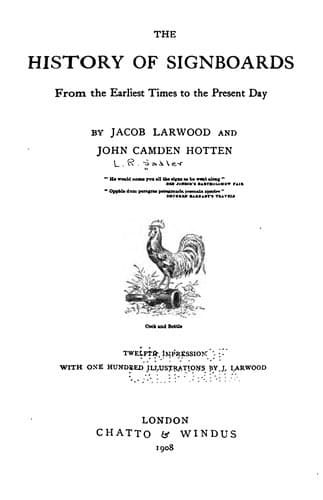
The History of Signboards, from the Earliest times to the Present Day — John Shaqi
The History of Signboards, from the Earliest times to the Present DayHotten, John Camden
History
The History of Signboards, from the Earliest times to the Present Day
Hotten, John Camden
Inn signs -- England -- History; Signs and signboards -- History
Yet, though the numbers were now an established fact, the shopkeepers
still clung to the old traditions, and for years continued to display
their signs, grand, gorgeous, and gigantic as ever, though affixed to
the houses. As late as 1803, a traveller thus writes about London:--“As
it is one of the principal secrets of the trade to attract the attention
of that tide of people which is constantly ebbing and flowing in the
streets, it may easily be conceived that great pains are taken to give a
striking form to the signs and devices hanging out before their shops.
The whole front of a house is frequently employed for this purpose.
Thus, in the vicinity of Ludgate Hill, the house of S----, who has
amassed a fortune of £40,000 by selling razors, is daubed with large
capitals three feet high, acquainting the public that ‘the most
excellent and superb patent razors are sold here.’ As soon, therefore,
as a shop has acquired some degree of reputation, the younger brethren
of the trade copy its device. A grocer in the city, who had a large
_Beehive_ for his sign hanging out before his shop, had allured a great
many customers. No sooner were the people seen swarming about this hive
than the old signs suddenly disappeared, and Beehives, elegantly gilt,
were substituted in their places. Hence the grocer was obliged to insert
an advertisement in the newspapers, importing ‘that he was the sole
proprietor of the original and celebrated _Beehive_.’ A similar accident
befell the shop of one E---- in Cheapside, who has a considerable demand
for his goods on account of their cheapness and excellence. The sign of
this gentleman consists in a prodigious _Grasshopper_, and as this
insect had quickly propagated its species through every part of the
city, Mr E---- has in his advertisements repeatedly requested the public
to observe that ‘the genuine Grasshopper is only to be found before his
warehouse.’ He has, however, been so successful as to persuade several
young beginners to enter into engagements with him, on conditions very
advantageous to himself, by which they have obtained a licence for
hanging out the sign of a Grasshopper before their shops, expressly
adding this clause in large capitals, that ‘they are genuine descendants
of the renowned and matchless Grasshopper of Mr E---- in
Cheapside.’”[41]
Such practices as these, however, necessarily gave the deathblow to
signboards; for, by reason of this imitation on the part of rival
shopkeepers, the main object--distinction and notoriety--was lost. How
was a stranger to know which of those innumerable Beehives in the Strand
was _the_ Beehive; or which of all those “genuine Grasshoppers” was THE
genuine one? So, gradually, the signs began to dwindle away, first in
the principal streets, then in the smaller thoroughfares and the
suburbs; finally, in the provincial towns also. The publicans only
retained them, and even they in the end were satisfied with the name
without the sign, _vox et præterea nihil_.
Public-domain text, read in full here on John Shaqi.
Reviews
Reviews
No reviews yet
Be the first to share your thoughts on this work.
Join the Discussion
Join the discussion
Sign in to leave a comment or review.
Sign InorCreate an account