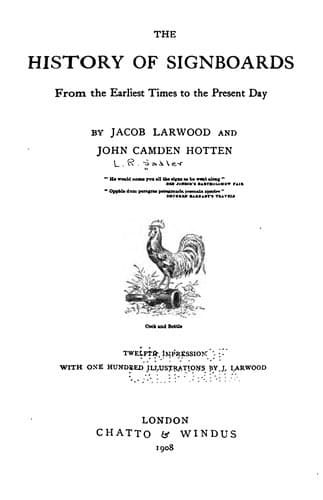
The History of Signboards, from the Earliest times to the Present DayHotten, John Camden
History
The History of Signboards, from the Earliest times to the Present Day
Hotten, John Camden
Inn signs -- England -- History; Signs and signboards -- History
Now _numbers_ appeared everywhere. As early as 1512 an attempt had been
made in Paris at numbering sixty-eight new houses, built in that year on
the Pont Nôtre-Dame, which were all distinguished by 1, 2, 3, 4, &c.;
yet more than two centuries elapsed before the numerical arrangement was
generally adopted. In 1787 the custom in France had become almost
universal, but was not enforced by police regulations until 1805. In
London it appears to have been attempted in the beginning of the
eighteenth century; for in Hatton’s “New View of London,” 1708, we see
that “in Prescott Street, Goodman’s Fields, instead of signs the houses
are distinguished by numbers, as the staircases in the Inns of Court and
Chancery.” In all probability reading was not sufficiently widespread at
that time to bring this novelty into general practice. Yet how much more
simple is the method of numbering, for giving a clear and unmistakable
direction, may be seen from the means resorted to to indicate a house
under the signboard system; as for instance:--
“TO BE LETT, Newbury House, in St James’s Park, next door but one to
Lady Oxford’s, having two balls at the gate, and iron rails before the
door,” &c., &c.--Advertisement in the original edition of the
_Spectator_, No. 207.
“AT HER HOUSE, the RED BALL AND ACORN, over against the GLOBE Tavern,
in Queen Street, Cheapside, near the _Three Crowns_, liveth a
Gentlewoman,” &c.
At night the difficulty of finding a house was greatly increased, for
the light of the lamps was so faint that the signs, generally hung
rather high, could scarcely be discerned. Other means, therefore, were
resorted to, as we see from the advertisement of “Doctor James Tilbrogh,
a German Doctor,” who resides “over against the New Exchange in Bedford
Street, at the sign of the Peacock, where you shall see at night two
candles burning within one of the chambers before the balcony, and a
lanthorn with a candle in it upon the balcony.” And in that strain all
directions were given: _over against_, or _next door to_, were among the
consecrated formulæ. Hence many dispensed with a picture of their own,
and clung, like parasites, to the sign opposite or next door,
particularly if it was a shop of some note. Others resorted to painting
their houses, doors, balconies, or doorposts, in some striking colour;
hence those Red, Blue, or White Houses still so common; hence also the
Blue Posts and the Green Posts. So we find a Dark House in Chequer
Alley, Moorfields, a Green Door in Craven Building, and a Blue Balcony
in Little Queen Street, all of which figure on the seventeenth century
trades tokens.[40] Those who did much trade by night, as coffee-houses,
quacks, &c., adopted lamps with coloured glasses, by which they
distinguished their houses. This custom has come down to us, and is
still adhered to by doctors, chemists, public-houses, and occasionally
by sweeps.
Public-domain text, read in full here on John Shaqi.
Reviews
Reviews
No reviews yet
Be the first to share your thoughts on this work.
Join the Discussion
Join the discussion
Sign in to leave a comment or review.
Sign InorCreate an account