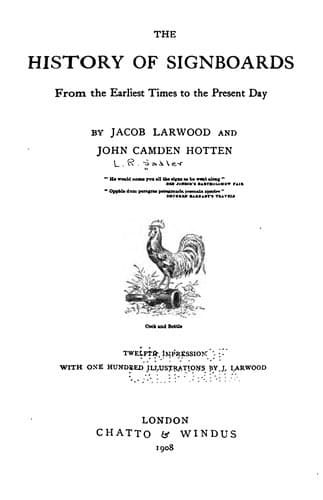
The History of Signboards, from the Earliest times to the Present DayHotten, John Camden
History
The History of Signboards, from the Earliest times to the Present Day
Hotten, John Camden
Inn signs -- England -- History; Signs and signboards -- History
Anecdotes and historical facts have been introduced with a double view;
first, as authentic proofs of the existence and age of the sign;
secondly, in the hope that they may afford variety and entertainment.
They will call up many a picture of the olden time; many a trait of
bygone manners and customs--old shops and residents, old modes of
transacting business, in short, much that is now extinct and obsolete.
There is a peculiar pleasure in pondering over these old houses, and
picturing them to ourselves as again inhabited by the busy tenants of
former years; in meeting the great names of history in the hours of
relaxation, in calling up the scenes which must have been often
witnessed in the haunt of the pleasure-seeker,--the tavern with its
noisy company, the coffee-house with its politicians and smart beaux;
and, on the other hand, the quiet, unpretending shop of the ancient
bookseller filled with the monuments of departed minds. Such scraps of
history may help to picture this old London as it appeared during the
last three centuries. For the contemplative mind there is some charm
even in getting at the names and occupations of the former inmates of
the houses now only remembered by their signs; in tracing, by means of
these house decorations, their modes of thought or their ideas of
humour, and in rescuing from oblivion a few little anecdotes and minor
facts of history connected with the house before which those signs swung
in the air.
It is a pity that such a task as the following was not undertaken many
years ago; it would have been much better accomplished then than now.
London is so rapidly changing its aspect, that ten years hence many of
the particulars here gathered could no longer be collected. Already,
during the printing of this work, three old houses famous for their
signs have been doomed to destruction--the Mitre in Fleet Street, the
Tabard in Southwark, (where Chaucer’s pilgrims lay,) and Don Saltero’s
house in Cheyne Walk, Chelsea. The best existing specimens of old
signboards may be seen in our cathedral towns. Antiquaries cling to
these places, and the inhabitants themselves are generally animated by a
strong conservative feeling. In London an entire street might be removed
with far less of public discussion than would attend the taking down of
an old decayed sign in one of these provincial cities. Does the reader
remember an article in _Punch_, about two years ago, entitled “Asses in
Canterbury?” It was in ridicule of the Canterbury Commissioners of
Pavement, who had held grave deliberations on the well-known sign of Sir
John Falstaff, hanging from the front of the hotel of that name,--a
house which has been open for public entertainment these three hundred
years. The knight with sword and buckler (from “Henry the Fourth,”) was
suspended from some ornamental iron-work, far above the pavement, in the
open thoroughfare leading to the famous Westgate, and formed one of the
most noticeable objects in this part of Canterbury.
Public-domain text, read in full here on John Shaqi.
Reviews
Reviews
No reviews yet
Be the first to share your thoughts on this work.
Join the Discussion
Join the discussion
Sign in to leave a comment or review.
Sign InorCreate an account