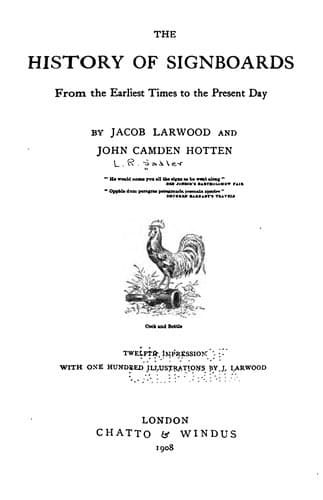
The History of Signboards, from the Earliest times to the Present DayHotten, John Camden
History
The History of Signboards, from the Earliest times to the Present Day
Hotten, John Camden
Inn signs -- England -- History; Signs and signboards -- History
In 1787, when the
general order was issued for the removal of all the signs in the
city--many of them obstructed the thoroughfares--this was looked upon
with so much veneration that it was allowed to remain until 1863, when
for no apparent reason it was sentenced to destruction. However, it was
only with the greatest difficulty that men could be found to pull it
down, and then several cans of beer had first to be distributed amongst
them as an incentive to action--in so great veneration was the old sign
held even by the lower orders of the place. Eight pounds were paid for
this destruction, which, for fear of a riot, was effected at three in
the morning, “amid the groans and hisses of the assembled multitude,”
says a local paper. Previous to the demolition the greatest excitement
had existed in the place; the newspapers were filled with articles; a
petition with 400 signatures--including an M.P., the prebends, minor
canons, and clergy of the cathedral--prayed the local “commissioners”
that the sign might be spared; and the whole community was in an uproar.
No sooner was the old portrait of Sir John removed than another was put
up; but this representing the knight as seated, and with a can of ale by
his side, however much it may suit the modern publican’s notion of
military ardour, does not please the owner of the property, and a
_fac-simile_ of the time-honoured original is in course of preparation.
Concerning the internal arrangement of the following work, a few
explanations seem necessary.
Where a street is mentioned without the town being specified, it in all
cases refers to a London thoroughfare.
The trades tokens so frequently referred to, it will be scarcely
necessary to state, were the brass farthings issued by shop or tavern
keepers, and generally adorned with a representation of the sign of the
house. Nearly all the tokens alluded to belong to the latter part of the
seventeenth century, mostly to the reign of Charles II.
As the work has been two years in the press, the passing events
mentioned in the earlier sheets refer to the year 1864.
In a few instances it was found impossible to ascertain whether certain
signs spoken of as existing really do exist, or whether those mentioned
as things of the past are in reality so. The wide distances at which
they are situated prevented personal examination in every case, and
local histories fail to give such small particulars.
The rude unattractive woodcuts inserted in the work are in most
instances _fac-similes_, which have been chosen as genuine examples of
the style in which the various old signs were represented. The blame of
the coarse and primitive execution, therefore, rests entirely with the
ancient artist, whether sign painter or engraver.
Public-domain text, read in full here on John Shaqi.
Reviews
Reviews
No reviews yet
Be the first to share your thoughts on this work.
Join the Discussion
Join the discussion
Sign in to leave a comment or review.
Sign InorCreate an account