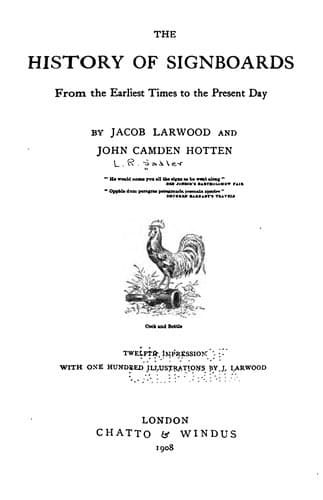
The History of Signboards, from the Earliest times to the Present DayHotten, John Camden
History
The History of Signboards, from the Earliest times to the Present Day
Hotten, John Camden
Inn signs -- England -- History; Signs and signboards -- History
representation of our great dramatic poet was sold for a trifle to Mason
the broker in Lower Grosvenor Street, where it stood at his door for
several years, until it was totally destroyed by the weather and other
accidents.[50]
The universal use of signboards furnished no little employment for the
inferior rank of painters, and sometimes even to the superior
professors. Among the most celebrated practitioners in this branch was a
person of the name of Lamb, who possessed considerable ability. His
pencil was bold and masterly, and well adapted to the subjects on which
it was generally employed. There was also Gwynne, another coach-painter,
who acquired some reputation as a marine painter, and produced a few
good signs. Robert Dalton, keeper of the pictures of King George III.,
had been apprenticed to a sign and coach-painter; so were Ralph Kirby,
drawing-master to George IV. when Prince of Wales, Thomas Wright of
Liverpool, the marine painter, Smirke, R.A., and many artists who
acquired considerable after-reputation.
Peter Monamy (_ob._ 1749) was apprenticed to a sign and house-painter on
London Bridge. It was this artist who decorated the carriage of Admiral
Byng with ships and naval trophies, and painted a portrait of Admiral
Vernon’s ship for a famous public-house of the day, well known by the
sign of the _Portobello_, a few doors north of the church in St Martin’s
Lane.[51]
Besides these, we have the “great professors,” as Edwards calls them,
who occasionally painted a sign for a freak. At the head of these stands
Hogarth, whose Man loaded with Mischief is still to be seen at 414
Oxford Street, where it is a fixture in the alehouse of that name.
Richard Wilson, R.A., (_ob._ 1782,) painted the Three Loggerheads for an
alehouse in North Wales, which gave its name to the village of
Loggerheads, near the town of Mould. The painting was still exhibited as
a signboard in 1824, though little of Wilson’s work remained, as it had
been repeatedly touched up.
George Morland painted several; the Goat in Boots on the Fulham Road is
attributed to him, but has since been painted often over; he also
painted a White Lion for an inn at Paddington, where he used to carouse
with his boon companions, Ibbetson and Rathbone; and in a small
public-house near Chelsea Bridge, Surrey, there was, as late as 1824, a
sign of the Cricketers painted by him. This painting by Morland, at the
date mentioned, had been removed inside the house, and a copy of it hung
up for the sign; unfortunately, however, the landlord used to travel
about with the original, and put it up before his booth at Staines and
Egham races, cricket matches, and similar occasions.
Ibbetson painted a sign for the village alehouse at Troutbeck, near
Ambleside, to settle a bill run up in a sketching, fishing, and
_dolce-far-niente_ expedition; the sign represented two faces, the one
thin and pale, the other jolly and rubicund; under it was the following
rhyme:--
Public-domain text, read in full here on John Shaqi.
Reviews
Reviews
No reviews yet
Be the first to share your thoughts on this work.
Join the Discussion
Join the discussion
Sign in to leave a comment or review.
Sign InorCreate an account