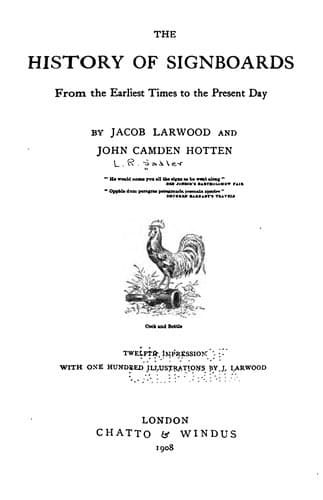
The History of Signboards, from the Earliest times to the Present Day — John Shaqi
The History of Signboards, from the Earliest times to the Present DayHotten, John Camden
History
The History of Signboards, from the Earliest times to the Present Day
Hotten, John Camden
Inn signs -- England -- History; Signs and signboards -- History
piece of plateglass, and so let into the woodwork.
And now a few words concerning the painters of signs. Their
head-quarters were in Harp Alley, Shoe Lane, where, until lately, gilt
grapes, sugar-loaves, lasts, teapots, &c., &c., were displayed ready for
the market. Here Messrs Barlow, Craddock, and others, whose names are
now as completely lost as their works, had their studios, and produced
some very creditable signs, both carved and painted. A few, however,
were the productions of no mean artists. The _Spectator_, January 8,
1743, No. 744, says:--
“The other day, going down Ludgate Street, several people were gaping
at a very splendid sign of Queen Elizabeth, which by far exceeded all
the other signs in the street, the painter having shewn a masterly
judgment and the carver and gilder much pomp and splendour. It looked
rather like a capital picture in a gallery than a sign in the street.”
Unfortunately the name of the artist who painted this has not come down
to us.
Those who produced the best signs, however, were not exactly the Harp
Alley sign-painters, but the coach-painters, who often united these two
branches of art. In the last century, both the coaches and sedans of the
wealthy classes were walking picture galleries, the panels being painted
with all sorts of subjects.[49] And when the men that painted these
turned their hands to sign-painting, they were sure to produce something
good. Such was Clarkson, to whom J. T. Smith ascribed the beautiful sign
of Shakespeare that formerly hung in Little Russell Street, Drury Lane,
for which he was paid £500.--John Baker, (_ob._ 1771,) who studied under
the same master as Catton, and was made a member of the Royal Academy at
its foundation.--Charles Catton (_ob._ 1798) painted several very good
signs, particularly a Lion for his friend Wright, a famous coachmaker,
at that time living in Long Acre. This picture, though it had weathered
many a storm, was still to be seen in J. T. Smith’s time, at a
coachmaker’s on the west side of Well Street, Oxford Street. A Turk’s
head, painted by him, was long admired as the sign of a mercer in York
Street, Covent Garden.--John Baptist Cipriani, (_ob._ 1785,) a
Florentine carriage-painter, living in London, also a Royal
Academician.--Samuel Wale, R.A. (_ob._ 1786) painted a celebrated
Falstaff and various other signs; the principal one was a whole length
of Shakespeare, about five feet high, which was executed for and
displayed at the door of a public-house at the north-west corner of
Little Russell Street, Drury Lane. It was enclosed in a most sumptuous
carved gilt frame, and was suspended by rich ironwork. But this splendid
object of attraction did not hang long before it was taken down, in
consequence of the Act of Parliament for removing the signs and other
obstructions in the streets of London. Such was the change in the public
appreciation consequent on the new regulations in signs, that this
Public-domain text, read in full here on John Shaqi.
Reviews
Reviews
No reviews yet
Be the first to share your thoughts on this work.
Join the Discussion
Join the discussion
Sign in to leave a comment or review.
Sign InorCreate an account