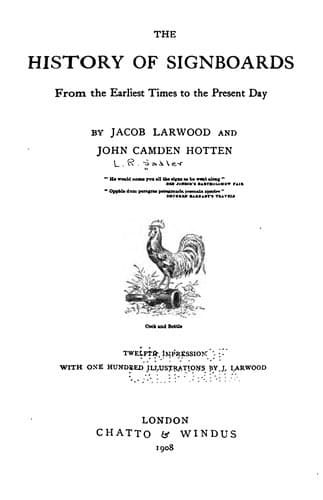
The History of Signboards, from the Earliest times to the Present DayHotten, John Camden
History
The History of Signboards, from the Earliest times to the Present Day
Hotten, John Camden
Inn signs -- England -- History; Signs and signboards -- History
[6] Lib. ii. sat. vii.: “I admire the position of the men that are
fighting, painted in red or in black, as if they were really alive;
striking and avoiding each other’s weapons, as if they were actually
moving.”
[7] De Oratore, lib. ii. ch. 71: “Now I shall shew you how you are, to
which he answered, ‘Do, please.’ Then I pointed with my finger towards
the Cock painted on the signboard of Marius the Cimberian, on the New
Forum, distorted, with his tongue out and hanging cheeks. Everybody
began to laugh.”
[8] Hist. Nat., xxxv. ch. 8: “After this I find that they were also
commonly placed on the Forum. Hence that joke of Crassus, the orator.
. . . On the Forum was also that of an old shepherd with a staff,
concerning which a German legate, being asked at how much he valued it,
answered that he would not care to have such a man given to him as a
present, even if he were real and alive.”
[9] “There were, namely, taverns round about the Forum, and that picture
[the Cock] had been put up as a sign.”
[10] The Bush certainly must be counted amongst the most ancient and
popular of signs. Traces of its use are not only found among Roman and
other old-world remains, but during the Middle Ages we have evidence of
its display. Indications of it are to be seen in the Bayeux tapestry, in
that part where a house is set on fire, with the inscription, _Hic domus
incenditur_, next to which appears a large building, from which projects
something very like a pole and a bush, both at the front and the back of
the building.
[11] In Cædmon’s Metrical Paraphrase of Scripture History, (_circa_ A.D.
1000,) in the drawings relating to the history of Abraham, there are
distinctly represented certain cruciform ornaments painted on the walls,
which might serve the purpose of signs. (_See_ upon this subject under
“RELIGIOUS SIGNS.”)
[12] The palace of St Laurence Poulteney, the town residence of Charles
Brandon, Duke of Suffolk, and also of the Dukes of Buckingham, was
called the Rose, from that badge being hung up in front of the house:--
“The Duke being at the Rose, within the parish
Of St Laurence Poultney.”--_Henry VIII._, a. i. s. 2.
“A house in the town of Lewes was formerly known as THE THREE PELICANS,
the fact of those birds constituting the arms of Pelham having been lost
sight of. Another is still called THE CATS,” which is nothing more than
“the arms of the Dorset family, whose supporters are two leopards
argent, spotted sable.”--LOWER, _Curiosities of Heraldry_.
[13] Rather a heavy fine, as the best ale at that time was not to be
sold for more than three-halfpence a gallon.
[14] “Purchaser, be aware when you wish to buy books issued from my
printing-office. Look at my sign, which is represented on the
title-page, and you can never be mistaken. For some evil-disposed
printers have affixed my name to their uncorrected and faulty works, in
order to secure a better sale for them.”
Public-domain text, read in full here on John Shaqi.
Reviews
Reviews
No reviews yet
Be the first to share your thoughts on this work.
Join the Discussion
Join the discussion
Sign in to leave a comment or review.
Sign InorCreate an account