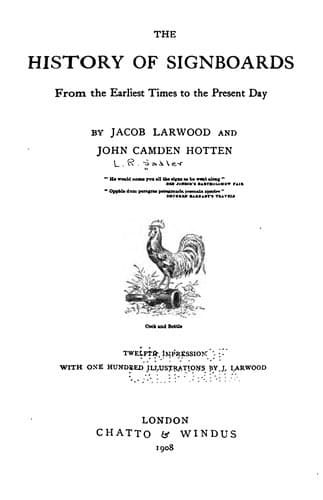
The History of Signboards, from the Earliest times to the Present DayHotten, John Camden
History
The History of Signboards, from the Earliest times to the Present Day
Hotten, John Camden
Inn signs -- England -- History; Signs and signboards -- History
[15] “We beg the reader to notice the sign, for there are men who have
adopted the same title, and the name of Badius, and so filch our
labour.”
[16] “Lastly, I must draw the attention of the student to the fact that
some Florentine printers, seeing that they could not equal our diligence
in correcting and printing, have resorted to their usual artifices. To
Aldus’s Institutiones Grammaticæ, printed in their offices, they have
affixed our well-known sign of the Dolphin wound round the Anchor. But
they have so managed, that any person who is in the least acquainted
with the books of our production, cannot fail to observe that this is an
impudent fraud. For the head of the Dolphin is turned to the left,
whereas that of ours is well known to be turned to the right.”--_Preface
to Aldus’s Livy_, 1518.
[17] The number of taverns in these ten shires was “686, or
thereabouts.”
[18] “The original court roll of this presentation is still to be found
amongst the records of the Dean and Chapter of Westminster.”--LYSON’S
_Env. of London_, vol. iii. p. 74.
[19] “Whosoever shall brew ale in the town of Cambridge, with intention
of selling it, must hang out a sign, otherwise he shall forfeit his
ale.”
[20] “Art. XXIII.--Tavernkeepers must put up signboards and a bush.
. . . Nobody shall be allowed to open a tavern in the said city and its
suburbs without having a sign and a bush.”
[21] A Cheat loaf was a household loaf, “wheaten seconds
bread.”--NARES’S _Glossary_.
[22] Froe--_i.e._ _Vrouw_, woman.
[23] This was in those days a slang term for a mistress.
[24] _i.e._ Walk about in St Paul’s during the dinner hour.
[25] “I have seen, hanging from the shops, shuttlecocks six feet high,
pearls as large as a hogshead, and feathers reaching up to the third
story.”
[26] “Koddige en ernstige opschriften op Luiffels, wagens, glazen,
uithangborden en andere tafereelen door Jeroen Jeroense. Amsterdam,
1682.”
[27] “Het gestoffeerde Winkelen en Luifelen Banquet. H. van den Berg.
Amsterdam, 1693.”
[28]
“Jacob was David’s nephew, but not his brother-in-law.
All sorts of barbers’ tools ground here, also fishwives’ and butchers’
knives.”
[29]
“Moses was pick’d up among the rushes.
Teeth and grinders drawn here.”
[30] The _British Apollo_, 1710, vol. iii. p. 34.
[31] Amusements for the Meridian of London, 1708, p. 72.
[32] Bell and the Dragon, still to be met on the signboard.
[33] Addison is wrong in this derivation, (_see_ under Miscellaneous
Signs, at the end.)
[34] From Martial and other Latin poets, we learn that it was usual for
the bibliopoles of those days to advertise new works by affixing copies
of the title-pages to a post outside their shops; but whether this
method obtained in the last century, the history of Paternoster Row does
not inform us.
[35] For the _Three Balls_ of the Pawnbrokers, _see_ under Miscellaneous
Signs; for the Barber’s Pole, under Trades’ Signs.
Public-domain text, read in full here on John Shaqi.
Reviews
Reviews
No reviews yet
Be the first to share your thoughts on this work.
Join the Discussion
Join the discussion
Sign in to leave a comment or review.
Sign InorCreate an account