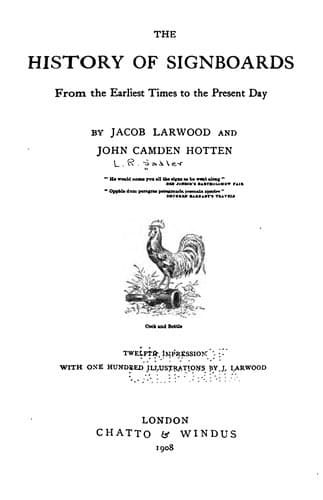
The History of Signboards, from the Earliest times to the Present DayHotten, John Camden
History
The History of Signboards, from the Earliest times to the Present Day
Hotten, John Camden
Inn signs -- England -- History; Signs and signboards -- History
A few of our own poets are also common tavern pictures. As early as 1655
we find a (Ben) JONSON’S HEAD tavern in the Strand, where Ben Jonson’s
chair was kept as a relic.[77] In that same year it was the sign of
Robert Pollard, bookseller, behind the Royal Exchange. Ten years later
it occurs in the following advertisement:--
“WHEREAS Thomas Williams, of the society of real and well-meaning
Chymists hath prepaired certain Medicynes for the cure and prevention
of the Plague, at cheap rates, without Benefit to himself, and for the
publick good, In pursuance of directions from authority, be it known
that these said Medicynes are to be had at Mr Thomas Fidges, in
Fountain Court, Shoe Lane, near Fleet Street, and are also left by him
to be disposed of at the GREEN BALL, within Ludgate, the Ben Jonson’s
Head, near Yorkhouse,” &c.[78]
There is still a Ben Jonson’s Head tavern with a painted portrait of the
poet in Shoe Lane, Fleet Street; a Ben Jonson’s Inn at Pemberton, Wigan,
Lancashire; and another at Weston-on-the Green, Bicester.
SHAKESPEARE’S HEAD is to be seen in almost every town where there is a
theatre. At a tavern with that sign in Great Russell Street, Covent
Garden, the Beefsteak Society (different from the Beefsteak Club,) used
to meet before it was removed to the Lyceum Theatre. George Lambert,
scene-painter to Covent Garden Theatre, was its originator. This tavern
was at one time famous for its beautifully painted sign. The well-known
Lion’s Head, first set up by Addison at Button’s, was for a time placed
at this house.[79] There was another Shakespeare Head in Wych Street,
Drury Lane, a small public-house at the beginning of this century, the
last haunt of the Club of Owls, so called on account of the late hours
kept by its members. The house was then kept by a lady under the
protection of Dutch Sam the pugilist. After this it was for one year in
the hands of the well-known Mr Mark Lemon, present editor of _Punch_,
then just newly married to Miss Romer, a singer of some renown, who
assisted him in the management of this establishment. The house was
chiefly visited by actors from Covent Garden, Drury Lane, and the
Olympic, whilst a club of literati used to meet on the first floor.
SIR JOHN FALSTAFF, who so dearly loved his sack, could not fail to
become popular with the publicans, and may be seen on almost as many
signboards as his parent Shakespeare.
Public-domain text, read in full here on John Shaqi.
Reviews
Reviews
No reviews yet
Be the first to share your thoughts on this work.
Elsewhere in the archive
Join the Discussion
Join the discussion
Sign in to leave a comment or review.
Sign InorCreate an account