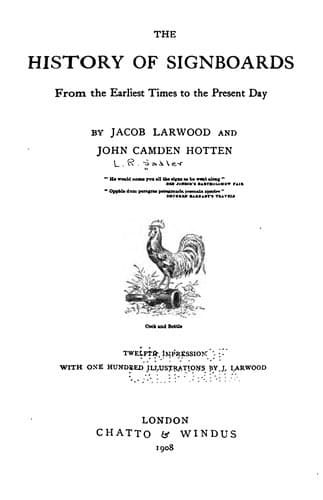
The History of Signboards, from the Earliest times to the Present DayHotten, John Camden
History
The History of Signboards, from the Earliest times to the Present Day
Hotten, John Camden
Inn signs -- England -- History; Signs and signboards -- History
MILTON’S HEAD was, in 1759, the sign of George Hawkins, a bookseller at
the corner of the Middle Temple gate, Fleet Street; at present there are
two Milton’s Head public-houses in Nottingham. DRYDEN’S HEAD was to be
seen in 1761, at the door of H. Payne and Crossley, booksellers in
Paternoster Row. At Kate’s Cabin, on the Great Northern Road, between
Chesterton and Alwalton, there is a sign of Dryden’s head, painted by
Sir William Beechey, when engaged as a house-painter on the decoration
of Alwalton Hall. Dryden was often in that neighbourhood when on a visit
to his kinsman, John Dryden of Chesterton.
POPE’S HEAD was in favour with the booksellers of the last century; thus
the _Gentleman’s Magazine_, Sept. 1770, mentions a head of Alexander
Pope in Paternoster Row, painted by an eminent artist, but does not say
who the painter was. Edmund Curll, the notorious bookseller in Rose
Street, Covent Garden, had Pope’s head for his sign, not out of
affection certainly, but out of hatred to the poet. After the quarrel
which arose out of Curll’s piratical publication of Pope’s literary
correspondence, Curll, in May 22, 1735, addressed a letter of thanks to
the House of Lords, ending thus,--“I have engraved a new plate of Mr
Pope’s head from Mr Jervas’s painting, and likewise intend to hang him
up in effigy for a sign to all spectators of his falsehood and my own
veracity, which I will always maintain under the Scotch motto, ‘Nemo me
impune lacessit.’” R. Griffiths, a bookseller in St Paul’s Churchyard
since 1750, had the DUNCIAD for his sign. He was agent for a very
primitive social-evil movement; advertisements emanating from this “sett
of gentlemen sympathising with the misfortunes of young girls” occur in
the papers of June and July 1752. One of the regulations was, “☞ None
need to apply but such as are Fifteen years of age, and not above
Twenty-five: older are thought past being reclaim’d, unless good
Recommendations are given. Drinkers of spirits and swearers have a bad
chance.”
The MAN OF ROSS is at the present day a signboard at Wye Terrace, Ross,
Herefordshire; the house in which John Kyrle, the Man of Ross, dwelt,
was, after his death, converted into an inn. Twenty or thirty years ago
the following poetical effusion was to be read stuck up in that inn:--
“Here dwelt the Man of Ross, O traveller here,
Departed merit claims the rev’rent tear.
Friend to the friendless, to the sick man health,
With generous joy he view’d his modest wealth.
If ’neath this roof thy wine-cheer’d moments pass,
Fill to the good man’s name one grateful glass.
To higher zest shall memory wake thy soul,
And virtue mingle in th’ ennobled bowl,
Here cheat thy cares, in generous visions melt,
And dream of goodness thou hast never felt.”
Public-domain text, read in full here on John Shaqi.
Reviews
Reviews
No reviews yet
Be the first to share your thoughts on this work.
Elsewhere in the archive
Join the Discussion
Join the discussion
Sign in to leave a comment or review.
Sign InorCreate an account