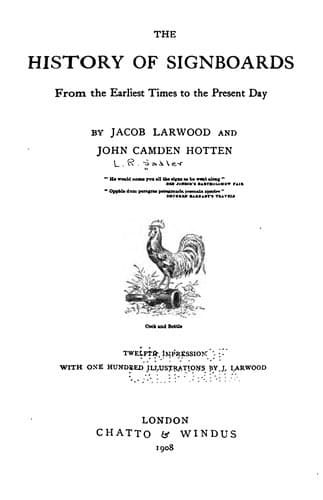
The History of Signboards, from the Earliest times to the Present DayHotten, John Camden
History
The History of Signboards, from the Earliest times to the Present Day
Hotten, John Camden
Inn signs -- England -- History; Signs and signboards -- History
The head of ROWE, the first emendator, corrector, and illustrator of
Shakespeare, was in 1735 the sign of a bookseller in Essex Street,
Strand. The CAMDEN HEAD and CAMDEN ARMS occur in four instances as the
sign of London publicans. Camden Town, however, may perhaps take the
credit of this last sign. ADDISON’S HEAD was for above sixty years the
sign of the then well-known firm of Corbett & Co.--first of C. Corbett,
afterwards of his son Thomas, booksellers in Fleet Street from 1740 till
the beginning of this century. DR JOHNSON’S HEAD, exhibiting a portrait
of the great lexicographer, is a modern sign in Bolton Court, Fleet
Street, opposite to where the great man lived, and which was in his time
occupied by an upholsterer. It is sometimes asserted to be the house in
which the Doctor resided, but this statement is wrong, for the house in
which he had apartments was burned down in 1819. Finally, a portrait of
Sterne, under the name of the YORICK’S HEAD, was the sign of John
Wallis, a bookseller in Ludgate Street in 1795.
Of modern poets LORD BYRON is the only one who has been exalted to the
signboard. In the neighbourhood of Nottingham his portrait occurs in
several instances; his MAZEPPA also is a great favourite, but it must be
confessed its popularity has been greatly assisted by the circus, by
sensational engravings, and, above all, by that love for horse flesh
innate to the British character. DON JUAN also occurs on a publican’s
signboard at Cawood, Selby, West Riding; and DON JOHN at Maltby,
Rotheram, in the same county; but perhaps these are merely the names of
race horses.
The latest of all literary celebrities who attained sufficient
popularity to entitle him to a signboard was SHERIDAN KNOWLES, who was
chosen as the sign of a tavern in Bridge Street, Covent Garden, facing
the principal entrance to Drury Lane Theatre, (now a nameless
eating-house.) There the Club of Owls used to meet. Sheridan Knowles was
one of the patrons, and Augustine Wade, an author and composer of some
fame, was chairman of the club in those days. Pierce Egan and Leman Rede
were amongst its members; so that it may be conjectured that the nights
were not passed in moping.[80]
Public-domain text, read in full here on John Shaqi.
Reviews
Reviews
No reviews yet
Be the first to share your thoughts on this work.
Elsewhere in the archive
Join the Discussion
Join the discussion
Sign in to leave a comment or review.
Sign InorCreate an account