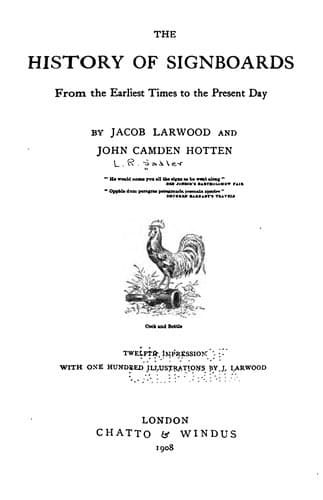
The History of Signboards, from the Earliest times to the Present DayHotten, John Camden
History
The History of Signboards, from the Earliest times to the Present Day
Hotten, John Camden
Inn signs -- England -- History; Signs and signboards -- History
Mythological divinities and heroes, also, have been very fairly
represented on our signboards. At this head, of course, BACCHUS
(frequently with the epithet of JOLLY) well deserves to be placed. In
the time when the BUSH was the usual alehouse sign, or rather when it
had swollen to a crown of evergreens, a chubby little Bacchus astride on
a tun was generally a pendant to the crown. In Holland and Germany we
have seen a Beer king, (a modern invention, certainly,) named Cambrinus,
taking the place of Bacchus at the beer-house door; but, according to
the sixteenth century notions, Bacchus included beer in his dominions.
Hence he is styled “Bacchus, the God of brew’d wine and sugar, grand
patron of robpots, upsey freesy tipplers, and supernaculum takers, this
Bacchus, who is head warden of Vintner’s Hall, _ale connor_, mayor of
all victualling houses,” &c.--MASSINGER’S _Virgin Martyr_, a. ii. s. l.
Next to Bacchus, APOLLO is most frequent, but whether as god of the sun
or leader of the Muses it is difficult to say. Sometimes he is called
GLORIOUS APOLLO, which, in heraldic language, means that he has a halo
round his head.[81] In the beginning of this century there was a
notorious place of amusement in St George’s Fields, Westminster Road,
called the Apollo Gardens--a Vauxhall or a Ranelagh of a very low
description. It was tastefully fitted up, but being small and having few
attractions beyond its really good orchestra, it became the resort of
the vulgar and the depraved, and was finally closed and built over.
MINERVA also is not uncommon--probably not so much because she was the
goddess of wisdom, but as “y^{e} patroness of scholars, shoemakers,
diers,” &c.[82] JUNO has a temple in Church Lane, Hull, and NEPTUNE of
course is of frequent occurrence in a country that holds the
“Imperium pelagi sævumque tridentem.”
The smith “being generally a thirsty soul, his patron VULCAN constitutes
an appropriate alehouse sign, and in that capacity he frequently
figures, particularly in the Black country. Amongst the quaint Dutch
signboard inscriptions there is one which, in the seventeenth century,
was written under a sign of Vulcan lighting his pipe:--
“_In Vulcanus._ Hy steekt zyn pyp op aan ’t vyer
Die goed tabak wil hebben die komt alhier.
Je krygt een gestopte pyp toe en op kermis een glas dik bier.”[83]
Vulcan, as the god of fire, without which there is no smoke, was a
common tobacconist’s sign in Holland two hundred years ago. One of these
dealers had the following rhymes affixed to his Vulcan sign:--
“Vulcan die lamme smid als hy was moei van smeden
Ging hy wat zitten neer en ruste zyne leden
De Goden zagen ’t aan, hy haalde uit zyn zak
Zyn pypye en zyn doos en rookte doen tabak.”[84]
Public-domain text, read in full here on John Shaqi.
Reviews
Reviews
No reviews yet
Be the first to share your thoughts on this work.
Elsewhere in the archive
Join the Discussion
Join the discussion
Sign in to leave a comment or review.
Sign InorCreate an account