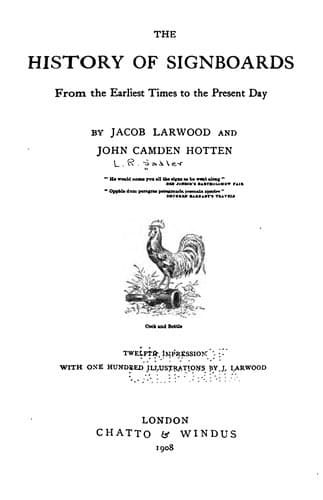
The History of Signboards, from the Earliest times to the Present DayHotten, John Camden
History
The History of Signboards, from the Earliest times to the Present Day
Hotten, John Camden
Inn signs -- England -- History; Signs and signboards -- History
In the cities of the East all trades are confined to certain streets, or
to certain rows in the various bazars and wekalehs. Jewellers,
silk-embroiderers, pipe-dealers, traders in drugs,--each of these
classes has its own quarter, where, in little open shops, the merchants
sit enthroned upon a kind of low counter, enjoying their pipes and their
coffee with the _otium cum dignitate_ characteristic of the Mussulman.
The purchaser knows the row to go to; sees at a glance what each shop
contains; and, if he be an _habitué_, will know the face of each
particular shopkeeper, so that under these circumstances, signboards
would be of no use.
With the ancient Egyptians it was much the same. As a rule, no picture
or description affixed to the shop announced the trade of the owner; the
goods exposed for sale were thought sufficient to attract attention.
Occasionally, however, there were inscriptions denoting the trade, with
the emblem which indicated it;[1] whence we may assume that this ancient
nation was the first to appreciate the benefit that might be derived
from signboards.
What we know of the Greek signs is very meagre and indefinite.
Aristophanes, Lucian, and other writers, make frequent allusions, which
seem to prove that signboards were in use with the Greeks. Thus
Aristotle says: ὡσπερ επι των καπηλιων γραφομενοι, μικροι μεν εισι,
φαινονται δε εχοντες πλατη και βαθη.[2] And Athenæus: εν προτεροις θηκη
διδασκαλιην.[3] But what their signs were, and whether carved, painted,
or the natural object, is entirely unknown.
With the Romans only we begin to have distinct data. In the Eternal
City, some streets, as in our mediæval towns, derived their names from
signs. Such, for instance, was the vicus Ursi Pileati, (the street of
“The Bear with the Hat on,”) in the Esquiliæ. The nature of their signs,
also, is well known. The BUSH, their tavern-sign, gave rise to the
proverb, “Vino vendibili suspensa hedera non opus est;” and hence we
derive our sign of the Bush, and our proverb, “Good Wine needs no
Bush.” An _ansa_, or handle of a pitcher, was the sign of their
post-houses, (_stathmoi_ or _allagæ_,) and hence these establishments
were afterwards denominated _ansæ_.[4] That they also had painted signs,
or exterior decorations which served their purpose, is clearly evident
from various authors:--
“Quum victi Mures Mustelarum exercitu
(Historia quorum in tabernis pingitur.)”[5]
PHÆDRUS, lib. iv. fab. vi.
These Roman street pictures were occasionally no mean works of art, as
we may learn from a passage in Horace:--
“Contento poplite miror
Proelia, rubrico picta aut carbone; velut si
Re vera pugnent, feriant vitentque moventes
Arma viri.”[6]
Cicero also is supposed by some scholars to allude to a sign when he
says:--
Public-domain text, read in full here on John Shaqi.
Reviews
Reviews
No reviews yet
Be the first to share your thoughts on this work.
Join the Discussion
Join the discussion
Sign in to leave a comment or review.
Sign InorCreate an account