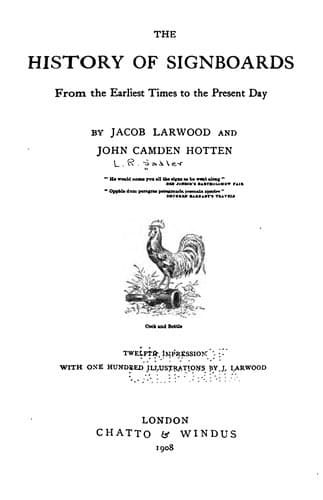
The History of Signboards, from the Earliest times to the Present DayHotten, John Camden
History
The History of Signboards, from the Earliest times to the Present Day
Hotten, John Camden
Inn signs -- England -- History; Signs and signboards -- History
“Jam ostendamcujus modi sis: quum ille ‘ostende quæso’ demonstravi
digito pictum Gallum in Mariano scuto Cimbrico, sub Novis, distortum
ejectâ linguâ, buccis fluentibus, risus est commotus.”[7]
Pliny, after saying that Lucius Mummius was the first in Rome who
affixed a picture to the outside of a house, continues:--
“Deinde video et in foro positas vulgo. Hinc enim Crassi oratoris
lepos, [here follows the anecdote of the Cock of Marius the Cimberian]
. . . In foro fuit et illa pastoris senis cum baculo, de qua
Teutonorum legatus respondit, interrogatus quanti eum æstimaret, sibi
donari nolle talem vivum verumque.”[8]
Fabius also, according to some, relates the story of the cock, and his
explanation is cited:--“Taberna autem erant circa Forum, ac scutum illud
signi gratia positum.”[9]
But we can judge even better from an inspection of the Roman signs
themselves, as they have come down to us amongst the ruins of
Herculaneum and Pompeii. A few were painted; but, as a rule, they appear
to have been made of stone, or terra-cotta relievo, and let into the
pilasters at the side of the open shop-fronts. Thus there have been
found a _goat_, the sign of a dairy; a _mule_ driving a mill, the sign
of a baker, (plate 1.) At the door of a schoolmaster was the not very
tempting sign of a boy receiving a good birching. Very similar to our
Two Jolly Brewers, carrying a tun slung on a long pole, a Pompeian
public-house keeper had two slaves represented above his door, carrying
an amphora; and another wine-merchant had a painting of Bacchus pressing
a bunch of grapes. At a perfumer’s shop, in the street of Mercury, were
represented various items of that profession--viz., four men carrying a
box with vases of perfume, men occupied in laying out and perfuming a
corpse, &c. There was also a sign similar to the one mentioned by
Horace, the Two Gladiators, under which, in the usual Pompeian
cacography, was the following imprecation:--ABIAT VENEREM POMPEIIANAMA
IRADAM QUI HOC LÆSERIT, _i.e._, _Habeat Venerem Pompeianam iratam_, &c.
Besides these there were the signs of the Anchor, the Ship, (perhaps a
ship-chandler’s,) a sort of a Cross, the Chequers, the Phallus on a
baker’s shop, with the words, HIC HABITAT FELICITAS; whilst in
Herculaneum there was a very cleverly painted Amorino, or Cupid,
carrying a pair of ladies’ shoes, one on his head and the other in his
hand.
Public-domain text, read in full here on John Shaqi.
Reviews
Reviews
No reviews yet
Be the first to share your thoughts on this work.
Join the Discussion
Join the discussion
Sign in to leave a comment or review.
Sign InorCreate an account