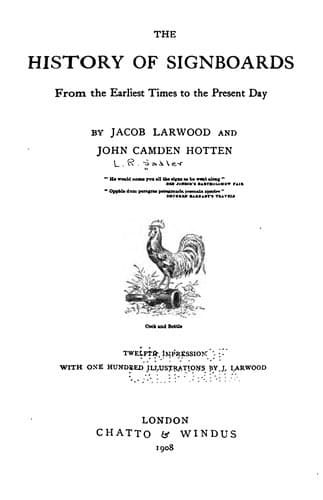
The History of Signboards, from the Earliest times to the Present DayHotten, John Camden
History
The History of Signboards, from the Earliest times to the Present Day
Hotten, John Camden
Inn signs -- England -- History; Signs and signboards -- History
“Coming from the Duke of York’s playhouse I got a coach, and a humour
took us and I carried them to the Hercules Pillars, and there did give
them a kind of supper of about 7s. and very merry, and home round the
town, not through the ruins. And it was pretty how the coachman by
mistake drives us into the ruins from London Wall unto Coleman Street,
and would persuade me that I lived there. And the truth is, I did
think that he and the linkman had contrived some roguery, but it
proved only a mistake of the coachman; but it was a cunning place to
have done us a mischief in, as any I know, to drive us out of the road
into the ruins, and there stop, while nobody could be called to help
us. But we came home safe.”
ATLAS carrying the World was the very appropriate sign of the map and
chart makers. In 1674 there was one in Cornhill,[87] and under a print
of Blanket fair (the fair held on the Thames when frozen over) occurs
the following imprint:--“A map of the river Thames merrily called
Blanket-fair, as it was frozen in the memorable year 1683-4, describing
the Booths, Footpaths, Coaches, Sledges, Bull-baitings, and other
remarks. Sold by Joseph Moxon on the West side of Fleet ditch, at the
sign of the ATLAS.” Equally appropriate was ORPHEUS as the sign of the
music shop of L. Peppard, next door to Bickerstaffe’s coffee-house,
Russell Street, Covent Garden, 1711. No fault either can be found with
the GOLDEN FLEECE as the sign of a woollen draper--Jason’s golden fleece
being an allegory of the wool trade, but at the door of an inn or
public-house it looks very like a warning of the fate the traveller may
expect within--in being fleeced. In the seventeenth century there was a
FLEECE Tavern in St James’s:--
“A RARE Consort of four Trumpets Marine, never heard of before in
England.[88] If any person desire to come and hear it, they may repair
to the Fleece Tavern near St James’s about 2 o’clock in the afternoon
every day in the week except Sundays. Every consort shall continue one
hour and so to begin again. The best places are 1 shilling, the others
sixpence.”--_London Gazette_, Feb. 1-4, 1674.
This is amongst the earliest concerts on record in London. Another
example of this sign worth mentioning was the Fleece Tavern, (in York
Street,) Covent Garden, which, says Aubrey, “was very unfortunate for
homicides; there have been several killed--three in my time. It is now
(1692) a private house. Clifton, the master, hanged himself, having
perjured himself.”[89] Pepys does not give this house a better
character:--“Decemb. 1, 1660. Mr Flower did tell me how a Scotch knight
was killed basely the other day at the Fleece in Covent Garden, where
there had been a great many formerly killed.” On the Continent, also,
this symbol was used; for instance, in 1687, by Jean Camusat, a printer
in the Rue St Jacques, Paris; his colophon represented Jason taking the
golden fleece off a tree, with the motto--“TEGIT ET QUOS TANGIT
INAURAT.”
Public-domain text, read in full here on John Shaqi.
Reviews
Reviews
No reviews yet
Be the first to share your thoughts on this work.
Elsewhere in the archive
Join the Discussion
Join the discussion
Sign in to leave a comment or review.
Sign InorCreate an account