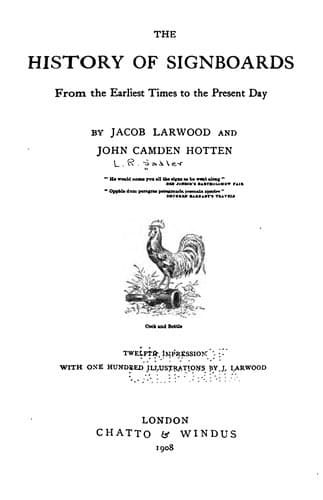
The History of Signboards, from the Earliest times to the Present DayHotten, John Camden
History
The History of Signboards, from the Earliest times to the Present Day
Hotten, John Camden
Inn signs -- England -- History; Signs and signboards -- History
Another sign, of which the application is not very obvious, is Pegasus
or the FLYING HORSE, unless it refers to this rhyme:--
“If with water you fill up your glasses,
You’ll never write anything wise;
For wine is the horse of Parnassus,
Which hurries a bard to the skies.”
“John Gay, at the Flying Horse, between St Dunstan’s Church and
Chancery Lane, 1680,” is an imprint under many ballads. John Gay
undoubtedly had adopted this sign as a compliment to the Templars, in
whose vicinity he lived, and whose arms are a Pegasus on a field _arg_.
As for the poor balladmongers, whose works Gay printed, they certainly
put Pegasus too much to the plough, to imagine that he alluded to theirs
as a Flying Horse. Instead of the Flying Horse, a facetious innkeeper at
Rogate Petersfield, has put up a parody in the shape of the FLYING BULL.
The HOPE and the HOPE AND ANCHOR are constant signs with shop and tavern
keepers. Pepys spent his Sunday, the 23d September 1660, at the Hope
Tavern, in a not very godly manner; and his account shews the curious
business management of the taverns in the time:--
“To the Hope and sent for Mr Chaplin, who with Nicholas Osborne and
one Daniel come to us, and we drank of two or three quarts of wine,
which was very good; the drawing of our wine causing a great quarrel
in the house between the two drawers which should draw us the best,
which caused a great deal of noise and falling out, till the master
parted them, and came up to us and did give us a long account of the
liberty he gives his servants, all alike, to draw what wine they will
to please his customers; and we eat above two hundred walnuts.”
In consequence of these excesses Master Pepys was very ill next day, but
the particulars of the illness, though very graphically entered into the
diary, are “unfit for publication.”
The FORTUNE was adopted from considerations somewhat similar to those
that prompted the choice of the Hope. It occurs as the sign of a tavern
in Wapping in 1667. The trades tokens of this house represent the
goddess by a naked figure standing on a globe, and holding a veil
distended by the wind,--a delicate hint to the customers, for it is a
well-known fact that a man who has “a sheet in the wind” is as happy as
a king. Doubtless the name of the ELYSIUM, a public-house in Drury Lane
about thirty years ago, had also been adopted as suggestive of the
happiness in store for the customers who honoured the place by their
company.
Public-domain text, read in full here on John Shaqi.
Reviews
Reviews
No reviews yet
Be the first to share your thoughts on this work.
Elsewhere in the archive
Join the Discussion
Join the discussion
Sign in to leave a comment or review.
Sign InorCreate an account