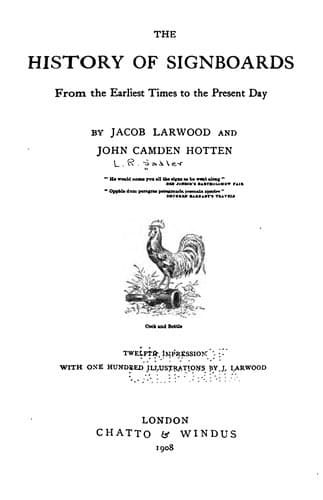
The History of Signboards, from the Earliest times to the Present DayHotten, John Camden
History
The History of Signboards, from the Earliest times to the Present Day
Hotten, John Camden
Inn signs -- England -- History; Signs and signboards -- History
Ballads, novels, chapbooks, and songs, have also given their contingent.
Thus, for instance, the BLIND BEGGAR OF BETHNAL GREEN--still a
public-house in the Whitechapel Road--has decorated the signpost for
ages. The ballad was written in the reign of Queen Elizabeth; but the
legend refers to Henry de Montfort, son of the Earl of Leicester, who
was supposed to have fallen at the battle of Evesham in the reign of
Henry III. Not only was the Beggar adopted as a sign by publicans, but
he also figured on the staff of the parish beadle; and so convinced were
the Bethnal Green folks of the truth of the story, that the house called
Kirby Castle was generally pointed out as the Blind Beggar’s palace, and
two turrets at the extremity of the court wall as the place where he
deposited his gains.
Still more general all over England is GUY OF WARWICK, who occurs
amongst the signs on trades tokens of the seventeenth century: that of
Peel Beckford, in Field Lane, represents him as an armed man holding a
boar’s head erect on a spear. The wondrous strange feats of this knight
form the subject of many a ballad. In the Roxburgh Collection there is
one headed, “The valiant deads of chivalry atchieved by that noble
knight, Sir Guy of Warwick, who, for the love of fair Phillis, became a
hermit, and dyed in a cave of a craggy rock a mile distant from Warwick.
In Normandy stoutly won by fight the Emperor’s daughter of Almayne from
many a valiant, worthy knight.”[90] His most popular feat is the slaying
of the DUN COW on Dunsmore Heath, which act of valour is commemorated on
many signs.
“By gallant Guy of Warwick slain
Was Colbrand, that gigantick Dane.
Nor could this desp’rate champion daunt
A dun cow bigger than elephaunt.
But he, to prove his courage sterling,
His whinyard in her blood embrued;
He cut from her enormous side a sirloin,
And in his porridge-pot her brisket stew’d,
Then butcher’d a wild boar, and eat him barbicu’d.”
_Huddersford Wiccamical Chaplet._
A public-house at Swainsthorpe, near Norwich, has the following
inscription on his sign of the Dun Cow:--
“Walk in, gentlemen, I trust you’ll find
The Dun Cow’s milk is to your mind.”
Another on the road between Durham and York:--
“Oh, come you from the east,
Oh, come you from the west,
If ye will taste the Dun Cow’s milk,
Ye’ll say it is the best.”
The KING AND MILLER is another ballad-sign seen in many places. It
alludes to the adventure of Henry II. with the Miller of Mansfield.[91]
Similar stories are told of many different kings: of King John and the
Miller of Charlton, (from whom Cuckold’s Point got its name;) of King
Edward and the tanner of Drayton Basset; of Henry VIII.; of James V. of
Scotland, (the guidman of Ballageich;) of Henry IV. of France and the
pig-merchant; of Charles V. of Spain and the cobbler of Brussels; of
Joseph II.; of Frederick the Great; and even of Haroun-al-Raschid, who
used to go about _incognito_ under the name of Il Bondocani.
Public-domain text, read in full here on John Shaqi.
Reviews
Reviews
No reviews yet
Be the first to share your thoughts on this work.
Elsewhere in the archive
Join the Discussion
Join the discussion
Sign in to leave a comment or review.
Sign InorCreate an account