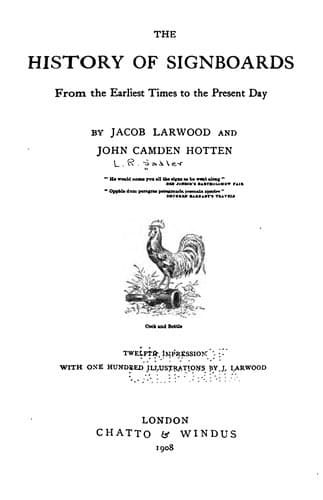
The History of Signboards, from the Earliest times to the Present DayHotten, John Camden
History
The History of Signboards, from the Earliest times to the Present Day
Hotten, John Camden
Inn signs -- England -- History; Signs and signboards -- History
The most frequent of all ballad signs is unquestionably ROBIN HOOD AND
LITTLE JOHN, his faithful accolyte. Robin Hood has for centuries enjoyed
a popularity amongst the English people shared by no other hero. He was
a crack shot, and of a manly, merry temper, qualities which made the mob
overlook his confused notions about _meum_ and _tuum_, and other
peccadilloes. His sign is frequently accompanied by the following
inscription:--
“You gentlemen, and yeomen good,
Come in and drink with Robin Hood.
If Robin Hood be not at home,
Come in and drink with Little John.”
Which last line a country publican, not very well versed in ballad lore,
thus corrected:--
“Come in and drink with Jemmie Webster.”
At Bradford, in Yorkshire, the following variation occurs:--
“Call here, my boy, if you are dry,
The fault’s in you, and not in I.
If Robin Hood from home is gone,
Step in and drink with Little John.”
At Overseal, in Leicestershire:--
“Robin Hood is dead and gone,
Pray call and drink with Little John.”
Finally, at Turnham Green:--
“Try Charrington’s ale, you will find it good.
Step in and drink with Robin Hood.
If Robin Hood,” &c.
And to shew the perfect application of the rhyme, mine host informs the
public that he is “Little John from the old PACK HORSE,” (a public-house
opposite.)
One of the ballads in Robin Hood’s Garland has given another signboard
hero, namely, the PINDAR OF WAKEFIELD,[92] George a Green.
“In Wakefielde there lives a jolly Pindar,
In Wakefielde all on the greene.
‘There is neither knight nor squire,’ said the Pindar,
‘Nor baron so bold, nor baron so bold,
Dares make a trespass to the town of Wakefielde,
But his pledge goes to the Pinfold.’”
Drunken Barnaby mentions the sign in Wakefield in 1634:--
“Straight at Wakefielde I was seen, a’,
Where I sought for George-a-Green, a’,
But could find not such a creature,
_Yet on sign I saw his feature_.
Whose strength of ale had so much stirr’d me,
That I grew stouter far than Jordie.”
There was formerly a public-house near St Chad’s Well, Clerkenwell,
bearing this sign, which at one period, to judge from the following
inscription, would seem to have been more famous than the celebrated
Bagnigge Wells hard by. A stone in the garden-wall of Bagnigge House
said:--
☩
S. T.
THIS IS BAGNIGGE
HOUSE, NEARE
THE PINDAR A
WAKEFEILDE.
1680.
Among the more uncommon ballad signs, we find the BABES IN THE WOOD at
Hanging Heaton, Dewsbury, West Riding. JANE SHORE was commemorated in
Shoreditch in the seventeenth century, as we see from trades tokens.
VALENTINE AND ORSON we find mentioned as early as 1711,[93] as the sign
of a coffee-house in Long Lane, Bermondsey; and there they remain till
the present day.
Public-domain text, read in full here on John Shaqi.
Reviews
Reviews
No reviews yet
Be the first to share your thoughts on this work.
Elsewhere in the archive
Join the Discussion
Join the discussion
Sign in to leave a comment or review.
Sign InorCreate an account