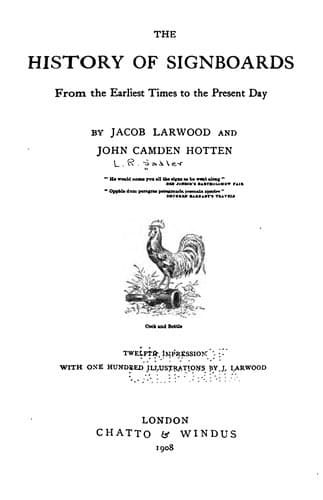
The History of Signboards, from the Earliest times to the Present DayHotten, John Camden
History
The History of Signboards, from the Earliest times to the Present Day
Hotten, John Camden
Inn signs -- England -- History; Signs and signboards -- History
Other chapbook celebrities are MOTHER SHIPTON, Kentish Town, and Low
Bridge, Knaresboro’; which latter village disputes with Shipton, near
Londesborough, the honour of giving birth to this remarkable character
in the month of July 1488. The fact is duly commemorated under her
signboard in the former place:--
“Near to this petrifying wall[94]
I first drew breath, as records tell.”
Her life and prophecies have at all times been a favourite theme in
popular literature. If we may believe her biographers, she predicted
the fall of Cardinal Wolsey, the dissolution of the monasteries, the
establishment of the Protestant religion under Edward VI., the cruelty
of Queen Mary, the glorious reign of Queen Elizabeth, the defeat of the
Armada, the Plague and Great Fire, and many things not yet come to pass.
Like the Delphic oracles, her predictions were given in metre, and
veiled in mystery. The plague and fire, for instance, are thus
foretold:--
“Triumphant death rides London thro’,
And men on tops of houses go.”
She is represented as of a most unprepossessing appearance; although we
certainly might have expected better from the daughter of a necromancer,
or “the phantasm of Apollo, or some aerial dæmon who seduced her
mother;”--“her body was long, and very big-boned; she had great goggling
eyes, very sharp and fiery; a nose of unproportionable length, having in
it many crooks and turnings, adorned with great pimples, and which, like
vapours of brimstone, gave such a lustre in the night, that the nurse
needed no other light to dress her by in her childhood.”[95]
Another necromancer, Merlin, shares renown with Mother Shipton, both in
chapbooks and on signboards. MERLIN’S CAVE is the sign of a public-house
in Great Audley Street, and in Upper Rosomon Street, Clerkenwell, in
which places he doubtless still plays his old pranks, of changing men
into beasts. Innumerable romances and histories of Merlin were printed
in the middle ages. He appears in Geoffrey of Monmouth as early as the
twelfth century, and Alain de l’Isle gave an ample explanation of his
prophecies in seven books, printed in 1608. “This Merlin,” says M. de la
Monnoye, “tout magicien et fils du diable que l’on l’a cru,” has by the
good Carmelite, Baptiste Mantuanus, been metamorphosed into a saint. At
the end of his “Tolentinum,” a poem in three books, in honour of St
Nicholas, (anno 1509,) he thus speaks of Merlin:--
“Vitæ venerabilis olim
Vir fuit et vates, venturi præscius ævi,
Merlinus, laris infando de semine cretus.
Hic satus infami coitu pietate refulsit
Eximia superum factus post funera consors.”[96]
Public-domain text, read in full here on John Shaqi.
Reviews
Reviews
No reviews yet
Be the first to share your thoughts on this work.
Elsewhere in the archive
Join the Discussion
Join the discussion
Sign in to leave a comment or review.
Sign InorCreate an account